Rakhi Special Sale Live Use "RAKHI10" Coupon Code
Rakhi Special Sale Live Use "RAKHI10" Coupon Code
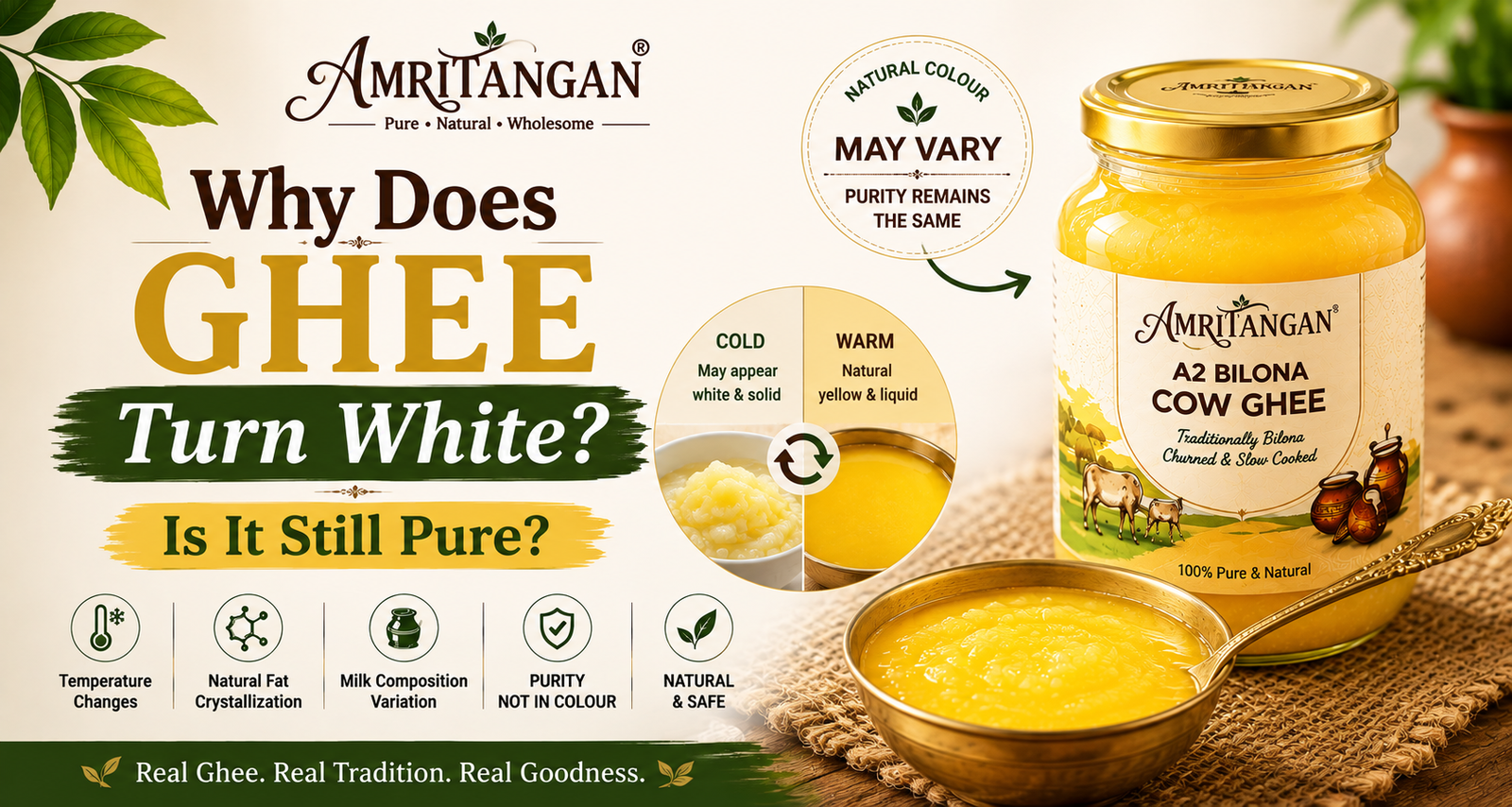
Have you ever opened a jar of ghee and noticed that it has become white, pale, or much lighter than before? If yes, you’re not alone. Many people immediately wonder, “Has my ghee gone bad?” or “Is white ghee fake?”
Because pure desi ghee is often shown as golden yellow, many people believe that good-quality ghee should always remain yellow. In reality, the colour of ghee can naturally change depending on temperature, milk fat composition, storage conditions, and the way it solidifies.
So, if your ghee has turned white or pale, there is no need to panic. A change in colour does not automatically mean that the ghee is spoiled or impure.
At the same time, colour alone is not enough to prove that a ghee is pure. The best way to judge ghee is by looking at its ingredients, preparation method, storage, and the transparency of the brand.
In this guide, we’ll explain why ghee turns white, why some ghee is yellow while others are pale, whether white ghee is still pure, and how to tell the difference between a natural colour change and actual spoilage.
Quick Answer: Why Does Ghee Turn White?
Ghee can turn white or pale as it cools because the milk fat naturally crystallizes. Lower temperatures and storage conditions can make these crystals more visible, giving the ghee a lighter appearance. White ghee is not automatically spoiled or impure.
The main reason ghee turns white is natural fat crystallization.
Ghee is almost entirely made up of milk fat. When it is warm, this fat is liquid and usually appears golden or translucent. As it cools, the fat begins to solidify and tiny crystals form.
These crystals scatter light differently, making the ghee appear:
This is a completely natural physical change.
Temperature has a major effect on how ghee looks.
When ghee is warm, it is usually:
As it cools, it becomes:
This is similar to how butter changes consistency when chilled.
Milk fat contains many different types of fats. These fats do not all solidify at the same temperature.
As the ghee cools, some fats form crystals earlier than others. The size and arrangement of these crystals affect the colour and texture of the final product.
This is also one reason why some ghee becomes grainy or danedar. If you want to understand this texture in more detail, read our guide on why Bilona Ghee becomes grainy.
The milk used to make ghee can also influence its natural colour.
Factors such as the cow breed, feed, season, and natural milk composition can cause slight differences in appearance from one batch to another.
That is why not every jar of pure ghee looks exactly the same.
Yes, white or pale ghee can still be completely pure.
A lighter colour by itself is not a sign of adulteration.
However, it is important to understand that colour alone cannot prove purity either.
When buying ghee, you should also consider:
In other words, white ghee can be pure, and yellow ghee can also be pure. The colour is just one visual characteristic.
There are several reasons why two jars of ghee may have slightly different colours.
| Factor | Effect on Ghee |
| Temperature | Can make ghee look lighter or darker |
| Milk composition | Influences natural colour |
| Fat crystallization | Can make ghee appear white or creamy |
| Storage conditions | Affect appearance and texture |
| Processing | May influence final colour |
| Natural batch variation | Different batches can look different |
The most important point is that there is no single colour that every pure ghee must have.
| Feature | White or Pale Ghee | Yellow Ghee |
| Can occur naturally? | Yes | Yes |
| Affected by temperature? | Yes | Yes |
| Can be pure? | Yes | Yes |
| Colour proves purity? | No | No |
| Can change after heating? | Yes | Yes |
Both white and yellow ghee can be natural. The difference often comes down to temperature, milk composition, and how the fat has crystallized.
Yes, colder temperatures can make ghee appear whiter or paler.
When the temperature drops:
You may also notice that the texture becomes more grainy or firm during winter.
This is normal and does not mean that the ghee has spoiled.
Often, yes.
When white or pale ghee is heated, the fat crystals melt. As the crystals disappear, the ghee becomes liquid and may look more transparent or golden.
The change usually follows this pattern:
Cold → White and Solid
Room Temperature → Soft
Warm → Liquid and More Yellow-Looking
When the ghee cools again, it may become pale or white once more.
This is simply a change in the physical state of the fat.
No, not necessarily.
A white colour by itself is not a sign that ghee has spoiled.
Here is the difference between a normal colour change and actual spoilage.
These are usually natural:
You should be cautious if you notice:
Always follow the best-before date and storage instructions printed on the product.
Instead of judging by colour alone, check the overall condition of the ghee.
Colour and texture can naturally change with temperature.
No.
This is one of the biggest myths about ghee.
Many people believe that pure desi ghee must always be deep yellow. In reality, natural ghee can range from pale cream to yellow depending on several factors.
The colour can be influenced by:
Therefore, it is not accurate to say that yellow ghee is always pure or that white ghee is always fake.
The complete product should be evaluated, not just its colour.
A2 Bilona Ghee can also show natural variations in colour and texture.
When it is warm, it may look more golden and transparent. As it cools and solidifies, it can become creamier or paler because of the natural crystallization of milk fat.
The same jar can therefore look different at different temperatures without any change in its overall quality.
This is one of the reasons why consumers should not judge A2 Bilona Ghee only by its colour.
At Amritangan, we understand that traditionally prepared ghee can naturally vary in appearance.
Our A2 Bilona Ghee is crafted using the traditional Bilona method, where milk is converted into curd, churned into butter, and then slowly clarified into ghee.
Because ghee is a natural food, its colour and texture can vary depending on factors such as:
A jar may appear more golden when warm and lighter or creamier after it has cooled.
These natural variations are part of the normal behaviour of traditionally prepared ghee and should not be used alone to judge purity.
Proper storage helps maintain the freshness and quality of ghee.
Follow these simple tips:
If you want to know whether ghee actually needs refrigeration, read our detailed guide on how to store A2 Bilona Ghee.
Fact: Natural ghee can range from pale cream to yellow.
Fact: Ghee can naturally become white or pale as it cools.
Fact: Colour alone is not a reliable quality test.
Fact: Temperature changes can naturally affect the appearance of ghee.
Fact: Both graininess and colour changes can occur naturally because of fat crystallization.
Ghee turns white or pale when its milk fat crystallizes during cooling. Lower temperatures make these crystals more visible.
White ghee can absolutely be pure. Colour alone cannot determine purity.
Refrigeration causes the milk fat to solidify and crystallize, making the ghee appear lighter or white.
Yes. Pure ghee can naturally range from pale cream to yellow.
Temperature, natural milk composition, storage conditions, and fat crystallization can all affect the colour of ghee.
Not necessarily. Both colours can occur naturally.
Yes. Cooler temperatures can make ghee appear paler because of fat crystallization.
Heating melts the fat crystals, which often makes the ghee appear more transparent or yellow again.
Check for rancid smell, mold, contamination, or an unusual taste. White colour alone is not a sign of spoilage.
Pure desi ghee can naturally range from pale cream to yellow. There is no single colour that proves purity.
So, why does ghee turn white?
The answer is usually very simple. As ghee cools, its milk fat naturally crystallizes, which can make it appear white, pale, or creamier than before. Temperature, storage conditions, and natural variations in milk fat can all influence its appearance.
The most important thing to remember is that white ghee is not automatically fake or spoiled. At the same time, colour alone should not be used as proof of purity.
Instead, look at the complete product—its ingredients, preparation method, storage, labeling, and the transparency of the brand behind it.
Traditionally prepared A2 Bilona Ghee can naturally show slight variations in colour and texture, especially as temperatures change. These visual differences are part of the natural behaviour of ghee and do not, by themselves, indicate a loss of quality.
If you’re looking for traditionally prepared ghee made using the Bilona method, explore Amritangan A2 Bilona Ghee, crafted with a focus on authenticity, natural flavour, and the timeless character of traditional desi cow ghee.
No account yet?
Create an AccountNeed help? Our team is just a message away