Rakhi Special Sale Live Use "RAKHI10" Coupon Code
Rakhi Special Sale Live Use "RAKHI10" Coupon Code
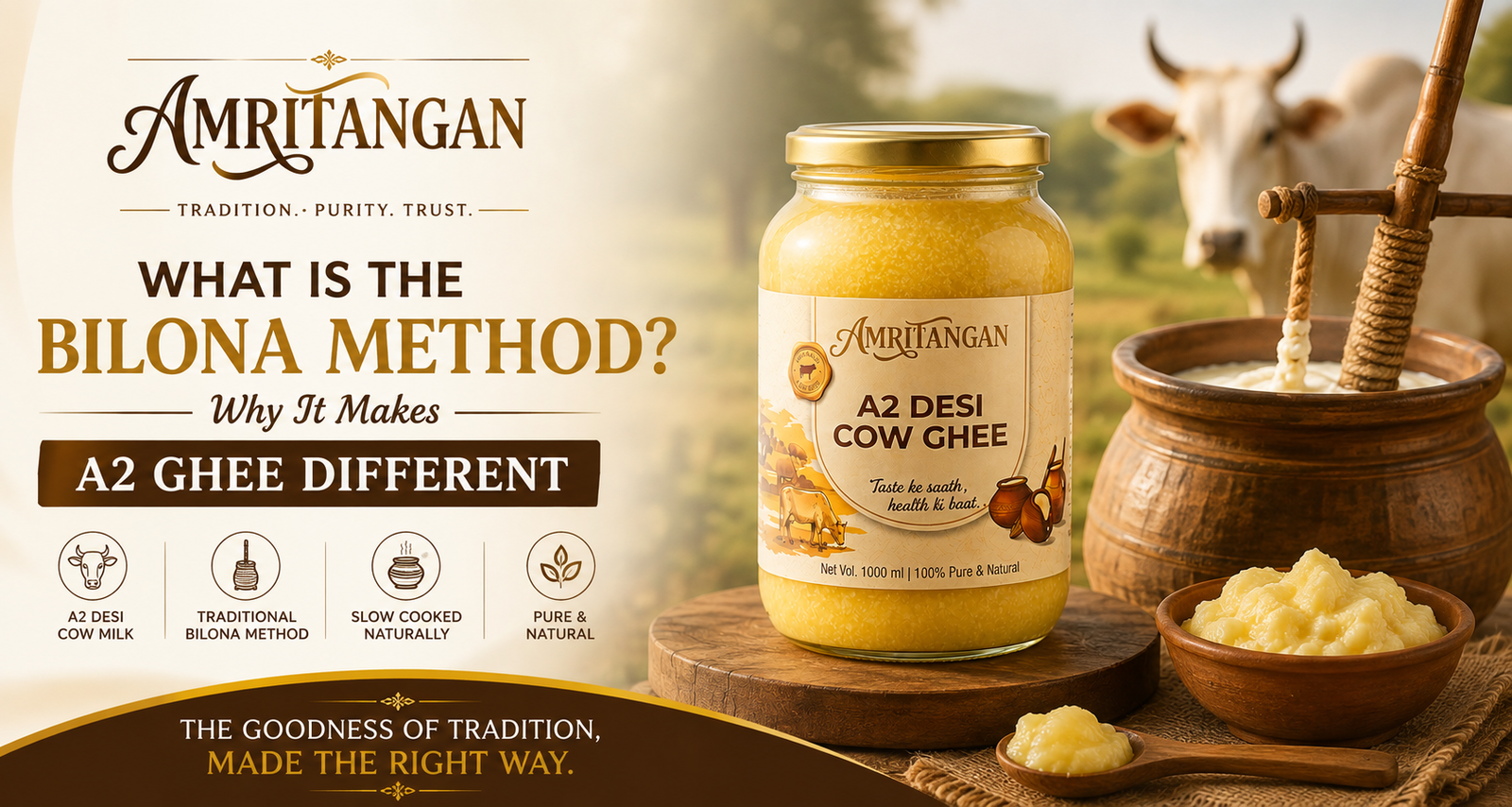
If you’ve been researching premium ghee, you’ve probably come across the term Bilona Method. It appears on product labels, health blogs, and traditional food websites—but what does it actually mean?
The Bilona Method is a centuries-old Indian technique used to prepare ghee from curd rather than directly from cream. This traditional process is valued for its craftsmanship and is still followed by brands committed to preserving authentic methods.
At Amritangan, we believe that understanding how your food is prepared is just as important as the ingredients themselves. That’s why our A2 Desi Cow Bilona Ghee is crafted using the traditional Bilona process, combining time-honoured practices with modern quality standards.
In this guide, you’ll learn:
Whether you’re buying ghee for everyday cooking or simply want to understand the traditional process, this guide will help you make an informed choice.
The Bilona Method is a traditional Indian technique of making ghee that has been practiced for generations. Unlike commercial production, which often starts with cream, the Bilona process begins with fresh whole milk.
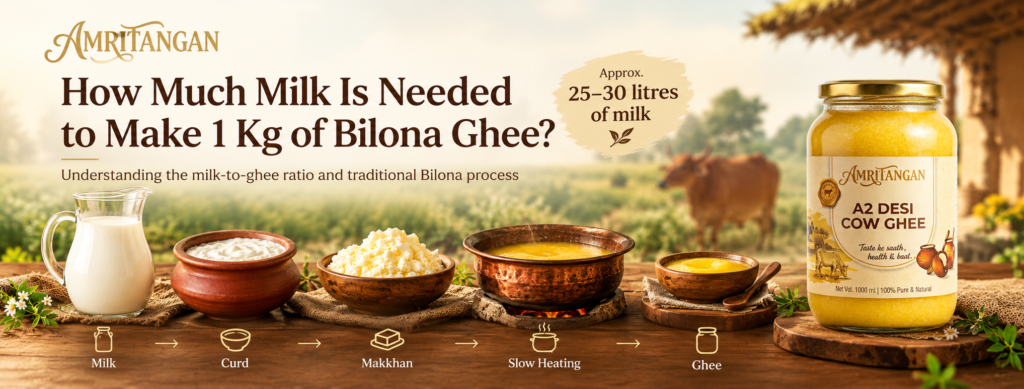
The word “Bilona” comes from the traditional wooden churner used to churn curd into butter. After fresh milk is boiled and naturally fermented into curd, it is slowly churned to separate butter from buttermilk. This butter is then gently heated over a low flame to produce aromatic, golden ghee.
This slow, handcrafted approach reflects India’s long-standing dairy traditions and is still appreciated by people looking for authentic preparation methods.
At Amritangan, we continue to follow this traditional Bilona process to create our A2 Desi Cow Bilona Ghee, maintaining the same step-by-step approach instead of taking industrial shortcuts.
👉 Explore Our A2 Desi Cow Bilona Ghee
The Bilona Method has deep roots in Indian culinary traditions. Long before industrial dairy processing, families prepared ghee at home using milk from their own cows.
The process was simple but required patience:
This method became an integral part of Indian households because it relied on simple ingredients and traditional techniques passed down through generations.
Today, while large-scale manufacturing has changed how much of the world’s ghee is produced, the Bilona Method remains a symbol of traditional craftsmanship.
At Amritangan, we are inspired by these age-old practices and continue to prepare our Bilona Ghee using the same traditional sequence of milk, curd, butter, and slow cooking.
Understanding the Bilona Method becomes easier when you look at each stage of the process.
The journey begins with fresh milk from A2 desi cows.
High-quality milk forms the foundation of authentic Bilona Ghee. Since the process starts with whole milk rather than cream, every stage that follows depends on the quality of the milk used.
At Amritangan, our focus is on sourcing quality A2 desi cow milk to support the traditional Bilona process.
The collected milk is gently boiled.
This is an important preparation step before the milk is transformed into curd. After boiling, the milk is allowed to cool naturally.
Instead of separating cream immediately, the cooled milk is cultured into curd using a natural starter.
This is one of the defining characteristics of the Bilona Method.
Unlike many commercial methods that work directly with cream, traditional Bilona Ghee follows the complete milk-to-curd process.
Once the curd is ready, it is slowly churned using a traditional wooden churner called a Bilona.
This gentle churning separates:
The slow pace of this process is one of the reasons Bilona Ghee production is more time-intensive than industrial methods.
After churning, the butter is carefully separated from the buttermilk.
This butter is completely different from butter produced through direct cream separation because it comes from naturally fermented curd.
The butter is then heated slowly over a controlled flame.
As moisture evaporates, the butter gradually transforms into aromatic golden ghee.
Slow cooking develops the rich flavour and traditional aroma associated with Bilona Ghee.
At Amritangan, we believe that this careful preparation is what makes traditional Bilona Ghee stand apart from fast industrial processes.
Many people today want to know not only what they eat but also how it is prepared.
The growing popularity of the Bilona Method reflects a broader interest in traditional food preparation, ingredient transparency, and artisanal craftsmanship.
Consumers increasingly look for products that clearly explain:
At Amritangan, transparency is an important part of our approach. Along with preparing A2 Desi Cow Bilona Ghee using the traditional Bilona Method, we also provide information about our quality standards through our Reports & Certificates page.
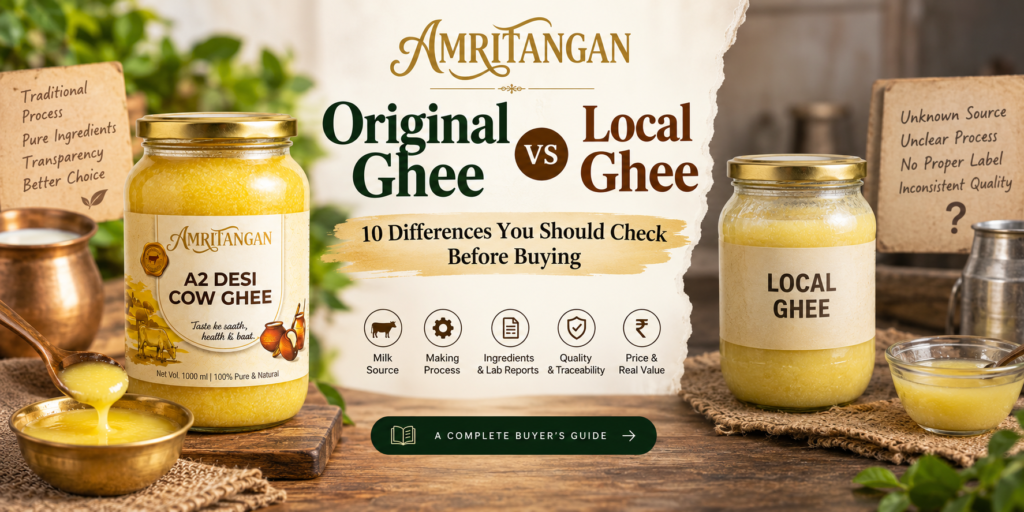
One of the biggest reasons the Bilona Method has gained popularity is because of how differently it approaches ghee production compared to modern commercial methods.
Although both products are called ghee, the preparation process, starting ingredients, and production time are very different.
| Feature | Traditional Bilona Method | Commercial Ghee Production |
| Starting Ingredient | Fresh Whole Milk | Cream |
| First Step | Milk → Curd | Cream Collection |
| Churning | Traditional Bilona Churning | Mechanical Processing |
| Butter Source | Cultured Butter | Cream Butter |
| Cooking Method | Slow Heating | Large-Scale Heating |
| Production Time | Longer | Faster |
| Batch Size | Small Batch | Large Batch |
| Preparation Style | Traditional | Industrial |
The Bilona Method focuses on traditional craftsmanship, while commercial production is designed for efficiency and large-scale manufacturing.
If you’d like to understand this comparison in greater detail, read our complete guide:
👉 Bilona Ghee vs Commercial Ghee
Many people notice that Bilona Ghee usually costs more than regular ghee and wonder why.
The answer lies in the production process.
Unlike commercial ghee that often begins with cream, Bilona Ghee starts with fresh milk.
Since milk must first become curd before butter can be prepared, the process naturally requires more time and resources.
Making authentic Bilona Ghee cannot be rushed.
The process includes:
Each stage contributes to the final product.
Many traditional Bilona producers prepare ghee in smaller batches instead of massive industrial quantities.
Small-batch production allows greater attention to quality and consistency.
At Amritangan, we also follow a carefully managed production process to maintain traditional preparation standards while ensuring quality checks at every stage.
Preparing Bilona Ghee requires experience.
The texture, aroma, and final consistency depend on careful handling throughout the process.
Traditional expertise is one reason handcrafted Bilona Ghee continues to be valued.
The Bilona Method has remained relevant for generations because many families appreciate its traditional approach.
Here are some reasons why it continues to be preferred.
The Bilona Method follows a sequence that has been practiced in Indian households for centuries.
Its focus is on craftsmanship rather than speed.
Slow preparation helps create the rich aroma and flavour that many people associate with traditional Bilona Ghee.
Whether you’re preparing dal, parathas, rice, or sweets, a small amount of Bilona Ghee can enhance the overall taste of the dish.
Traditional production often allows better monitoring throughout every stage of the process.
Instead of focusing only on quantity, the emphasis remains on consistency and authenticity.
Brands that explain their preparation process help customers make informed purchasing decisions.
Transparency builds trust.
At Amritangan, we believe customers should know exactly how their Bilona Ghee is prepared.
The Bilona Method reflects India’s long-standing dairy heritage.
For many families, choosing Bilona Ghee is also a way of supporting traditional food preparation methods that have been valued for generations.
With increasing demand, many products now claim to be “Bilona Ghee.”
Before buying, look for these indicators:
Choose products with transparent ingredient lists.
The manufacturer should clearly explain the production process instead of simply using the word “Bilona.”
Trusted brands often provide laboratory testing or quality certificates.
👉 View Amritangan Reports & Certificates
Look for brands that openly discuss:
Proper food-grade packaging helps preserve freshness and product quality.
If you’d like a more detailed guide, read:
When choosing Bilona Ghee, the brand you buy from matters just as much as the production method.
At Amritangan, our goal is to preserve the authenticity of the traditional Bilona Method while maintaining modern quality standards.
✔ Prepared using the Traditional Bilona Method
✔ Made from A2 Desi Cow Milk
✔ Slow-Cooked for Rich Aroma
✔ Small Batch Production
✔ Carefully Packed for Freshness
✔ Lab-Tested Quality
✔ Transparent Manufacturing Process
✔ No Artificial Preservatives
Whether you’re preparing everyday meals or festive recipes, Amritangan A2 Desi Cow Bilona Ghee is crafted to bring traditional flavour to your kitchen.
If you found this guide useful, you may also like:
The Bilona Method is a traditional Indian process of making ghee from curd instead of cream. Fresh milk is first converted into curd, churned into butter using a wooden Bilona churner, and then slowly heated to produce aromatic Bilona Ghee.
The traditional Bilona process uses curd because it follows the age-old milk → curd → butter → ghee sequence that has been practiced in Indian households for generations.
Yes. Bilona Ghee and regular ghee differ mainly in the preparation method. Bilona Ghee is made from cultured curd, while commercial ghee is often produced directly from cream.
👉 Read More: Bilona Ghee vs Commercial Ghee
Bilona Ghee takes longer to prepare and involves multiple traditional steps such as curd fermentation, slow churning, and small-batch cooking. These factors contribute to its higher production cost.
It depends on the brand. Bilona refers to the method of preparation, while A2 refers to the type of milk used. At Amritangan, our Bilona Ghee is prepared from A2 Desi Cow Milk using the traditional Bilona Method.
The Bilona Method takes significantly longer than commercial production because it includes milk fermentation, churning, butter separation, and slow cooking.
Bilona Ghee is commonly used in Indian households for everyday cooking. Individual dietary needs vary, so it should be consumed as part of a balanced diet.
Look for:
👉 Related Guide: 10 Signs of Pure Desi Ghee
Yes. Bilona Ghee is widely used for preparing dal, vegetables, parathas, rice, sweets, and many traditional Indian recipes.
👉 Read More: Best Ghee for Cooking
Choose a trusted brand that explains its sourcing, preparation method, and quality standards. You can explore Amritangan A2 Desi Cow Bilona Ghee on our product page and shop.
👉 https://amritangan.com/shop/
The Bilona Method is much more than a traditional way of making ghee—it’s a process that reflects generations of Indian dairy craftsmanship. From converting fresh milk into curd to slowly churning butter and carefully heating it into golden ghee, every step requires patience and attention to detail.
Today, while many commercial methods focus on speed and large-scale production, the Bilona Method continues to be valued for its traditional preparation and authentic character. Understanding this process helps you make informed choices when selecting ghee for your family.
At Amritangan, we are committed to preserving this tradition by preparing A2 Desi Cow Bilona Ghee using the authentic Bilona Method. Our focus on transparency, quality, and traditional craftsmanship ensures that every jar reflects the values behind this age-old process.
If you’re looking for traditionally prepared Bilona Ghee, explore the Amritangan collection and discover the difference that careful preparation can make.
👉 Shop Now
Add this section near the end of the blog to increase page views and strengthen topical authority.
No account yet?
Create an AccountNeed help? Our team is just a message away





2 thoughts on “What Is the Bilona Method? Why It Makes A2 Ghee Different”