Rakhi Special Sale Live Use "RAKHI10" Coupon Code
Rakhi Special Sale Live Use "RAKHI10" Coupon Code
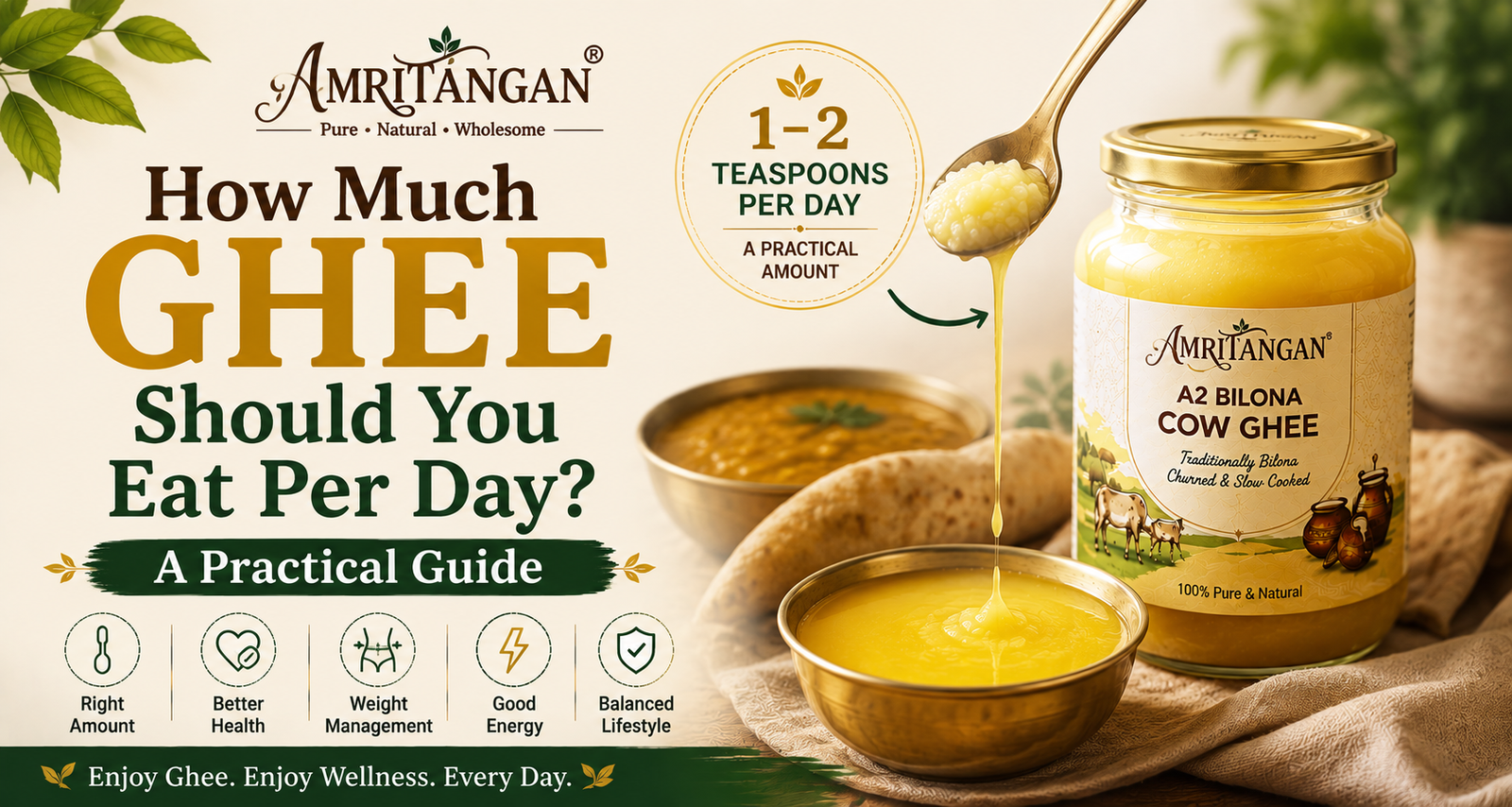
Ghee has been a familiar part of Indian kitchens for generations. A little ghee on dal, roti, rice or khichdi can add a rich flavour and make a simple meal feel more satisfying.
But one question often comes up:
Some people avoid ghee completely because they are worried about fat and calories. Others believe that because ghee is natural, having several spoonfuls every day must be beneficial.
The practical answer lies somewhere in between.
Ghee can be included in a balanced diet, but portion size matters. Ghee is a concentrated source of fat, so even a small serving contributes calories and should be considered along with other oils and fats in your diet.
The 2024 Dietary Guidelines from ICMR-NIN advise limiting ghee or butter to 1–2 teaspoons per day, while noting that total visible-fat needs vary according to energy requirements and lifestyle.
So, whether you enjoy regular desi ghee or A2 Bilona Ghee, the goal isn’t to eat as much as possible. It’s to use the right amount as part of your overall eating pattern.
Let’s understand what a practical daily serving looks like.
For many healthy adults, 1–2 teaspoons of ghee per day is a practical amount, especially when ghee is being counted as part of the day’s overall fat intake. Your individual needs can be different depending on your diet, activity level and health requirements.
For many healthy adults, 1–2 teaspoons of ghee per day is a simple and practical guideline.
This doesn’t mean that every person must consume exactly two teaspoons every day.
Your total dietary fat matters too.
For example, if you already use cooking oil for several meals and regularly eat foods such as butter, fried foods, nuts, seeds or other high-fat foods, adding several extra spoonfuls of ghee may significantly increase your overall fat and calorie intake.
ICMR-NIN’s 2024 Dietary Guidelines state that visible fats should be limited according to energy requirements and specifically recommend limiting ghee or butter to 1–2 teaspoons per day.
The important takeaway is:
Ghee can be part of your diet, but more is not automatically better.
Ghee is a concentrated fat, which means a relatively small quantity provides a significant amount of energy.
Ghee contains almost no water and is primarily fat.
That makes it flavourful and useful for cooking, but it also means that portions can add up quickly.
For example, one teaspoon may seem like a very small amount. But if you use a spoonful while cooking, another spoonful over your dal and more on your roti, your total intake can become much higher than you intended.
That’s why measuring your ghee occasionally can be useful, especially if you’re trying to manage your calorie intake.
Ghee contributes saturated fat to the diet.
This doesn’t mean you have to completely avoid it, but it does mean moderation is important.
Instead of thinking:
“Ghee is healthy, so I can eat unlimited amounts.”
A better approach is:
“I enjoy ghee, so I’ll use a sensible amount as part of a balanced diet.”
Here’s a simple way to think about portions:
| Daily Ghee | Practical View |
½ teaspoon | Small serving |
| 1 teaspoon | Conservative daily serving |
| 1–2 teaspoons | Practical range for many adults |
| 3+ teaspoons | Consider your total daily fat intake |
| Several tablespoons daily | May add a substantial amount of calories and fat |
There is no universal number that applies to every person.
Your age, body size, physical activity, overall diet and health requirements can all influence how much dietary fat you need.
Your lifestyle can make a difference to your overall calorie and fat requirements.
If you spend most of the day sitting and have relatively low physical activity, keeping portions moderate is especially important.
A small amount of ghee can add flavour without unnecessarily increasing the amount of fat in your meals.
People who exercise regularly may have higher energy requirements.
However, being active doesn’t mean you need unlimited ghee.
Your overall diet should still provide an appropriate balance of carbohydrates, protein, fats, fruits, vegetables and other nutrient-rich foods.
Ghee can easily fit into traditional meals.
You might use a small amount with:
The key is to remember that ghee used during cooking also counts toward your total intake.
This is where there is a lot of confusion online.
You may have seen claims that eating ghee can automatically burn fat or help you lose belly fat.
That’s not how weight management works.
Ghee is calorie-dense, so eating large amounts can actually make it harder to maintain a calorie deficit.
If you’re trying to lose weight, you don’t necessarily have to remove ghee completely. Instead:
A small amount of ghee can fit into a balanced weight-management diet.
The important factor is your overall dietary pattern, not one ingredient by itself.
For many people, a small amount of ghee can fit into an otherwise balanced diet.
But “eating ghee every day” doesn’t mean eating several tablespoons every day.
The better question is:
If you use a teaspoon of ghee with your lunch and eat a balanced diet, that’s very different from consuming multiple tablespoons on top of an already high-fat diet.
The 2024 ICMR-NIN guidelines emphasize moderation of visible fats and specifically recommend limiting ghee or butter to 1–2 teaspoons per day.
So, daily consumption can be practical for some people, but portion size and the rest of your diet matter.
You don’t necessarily need to follow a strict “best time” to eat ghee.
There is no need to force yourself to consume ghee first thing in the morning simply because it is trending online.
You can include a small amount with a regular meal.
A small amount can be used with foods such as roti, paratha or other breakfast dishes.
Ghee can be added to dal, rice or vegetables.
A small amount can also be used with a balanced evening meal.
The total amount you consume matters more than following a specific clock time.
Choose the timing that naturally fits your meals and eating habits.
This is an important point that people often overlook.
If you’re using ghee for cooking, you should count that amount as part of your daily intake.
For example:
That’s already 3 teaspoons.
So instead of adding ghee freely, try measuring it when possible.
A2 Bilona Ghee is still ghee from a dietary-fat perspective, so the same principle of portion control applies.
The Bilona method describes a traditional preparation process involving curd, churning and butter clarification. But the traditional preparation method doesn’t mean that you need to consume unlimited quantities.
For many healthy adults, 1–2 teaspoons per day can be a practical amount, depending on the rest of their diet.
If you’re adding A2 Bilona Ghee to your meals, consider the amount you use for both cooking and serving.
The goal is to enjoy the flavour and traditional character of ghee while keeping your overall dietary fat intake balanced.
Not necessarily.
Terms such as A2 and Bilona describe aspects of the product’s sourcing and preparation, but they don’t mean that portion control no longer matters.
A2 Bilona Ghee can be enjoyed in the same practical ways as other ghee:
The important thing is to consider the quantity you consume throughout the day.
If you’re interested in storage, you can also read our guide on how to store A2 Bilona Ghee.
Related Reading – Why Does Ghee Turn White? Is It Still Pure?
While a moderate amount of ghee can fit into many diets, some people may need more individualized dietary advice.
This includes people who:
If your doctor or dietitian has advised you to limit saturated fat or dietary fat, follow that personalized advice rather than a general internet recommendation.
This article provides general nutrition information and isn’t a substitute for individual medical advice.
Ghee is a traditional food, but that doesn’t mean you need large amounts of it.
Many people count the ghee they spread on their roti but forget the ghee already used while cooking.
You may see recommendations to consume several tablespoons of ghee every morning.
Such recommendations aren’t appropriate for everyone.
Ghee itself doesn’t guarantee weight loss.
Your overall calorie intake and lifestyle matter much more.
A tablespoon and teaspoon are very different quantities.
If portion control matters to you, use an actual teaspoon for measurement.
A balanced diet can include different sources of dietary fat. Simply replacing one fat with large amounts of another isn’t automatically healthier.
You don’t need complicated recipes to enjoy ghee.
A small amount of ghee can add a rich flavour to dal.
Instead of heavily coating your roti, try a light layer.
A teaspoon can add flavour and richness to a simple bowl of khichdi.
A small amount of ghee can complement rice, especially alongside dal or vegetables.
If you’re using ghee instead of another cooking fat, measure the amount so that your overall intake stays reasonable.
For more information about the traditional preparation process, you can also explore our guide to the traditional Bilona method.
No.
This is perhaps the most important takeaway from this article.
Ghee can be a useful and enjoyable part of Indian cooking, but consuming more doesn’t automatically mean getting more health benefits.
A balanced approach is better:
Good-quality food + sensible portions + a varied diet + regular physical activity
rather than relying on one ingredient.
If you’re interested in understanding what you’re actually paying for when buying traditionally prepared ghee, read our guide on whether A2 Bilona Ghee is worth the price.
At Amritangan, we believe ghee is best enjoyed as part of everyday Indian meals—not treated as a miracle food.
Our focus is on traditionally prepared A2 Desi Cow Ghee, made using the Bilona approach and intended to bring the rich taste and character of traditional ghee to modern kitchens.
You can enjoy it in simple meals such as:
Whether you choose to have one teaspoon or another amount that fits your individual dietary needs, the important thing is to use ghee mindfully and consider your total daily fat intake.
For many healthy adults, 1–2 teaspoons per day is a practical amount. ICMR-NIN’s 2024 Dietary Guidelines specifically advise limiting ghee or butter to 1–2 teaspoons per day, while overall fat needs vary with energy requirements and diet.
Yes. One teaspoon is a modest amount that can easily be included with a meal. You don’t need to consume a large quantity of ghee to enjoy its flavour.
For many healthy adults, 1–2 teaspoons can be a reasonable amount within a balanced diet. However, your total fat intake and individual health requirements also matter.
A moderate amount of ghee can fit into a balanced diet for many people. The important thing is to keep the portion reasonable and account for other sources of fat.
A practical starting point for many healthy adults is 1–2 teaspoons per day, while considering your overall dietary fat intake. Individual requirements can vary.
Ghee itself does not guarantee weight loss. Because it is calorie-dense, large amounts can add significant calories. Weight management depends on your overall diet, calorie intake and activity.
A small amount can be included with breakfast if it fits your overall diet. There is no need to consume a large quantity first thing in the morning.
For many people, a small amount with dinner can be fine. There is no universal requirement that ghee must be consumed at a particular time of day.
Yes. Eating large amounts can significantly increase your calorie and saturated-fat intake. Portion size matters.
Yes. Ghee used during cooking counts toward your overall daily intake just like ghee added directly to food.
The Bilona method refers to a traditional preparation process. However, it doesn’t mean you should consume unlimited quantities. Portion size and your overall diet remain important.
People with certain health conditions or dietary restrictions may need to limit ghee or saturated fat more carefully. If you have been given specific dietary advice by a healthcare professional, follow that advice.
So, how much ghee should you eat per day?
For many healthy adults, 1–2 teaspoons per day is a simple and practical amount, and this aligns with the 2024 ICMR-NIN guidance to limit ghee or butter to 1–2 teaspoons daily.
But the exact amount isn’t the same for everyone.
Your total diet, activity level, calorie needs and individual health requirements all matter. If you already consume other cooking oils, butter or high-fat foods, remember to consider those as part of your overall dietary fat intake.
The biggest mistake is thinking that more ghee automatically means more benefits.
Instead, enjoy ghee in sensible portions—with dal, roti, rice, khichdi, vegetables or your favourite traditional dishes.
At Amritangan, we believe good food doesn’t need to be complicated. Choose quality, use sensible portions, and enjoy the traditional goodness of A2 Bilona Ghee as part of a balanced diet.
No account yet?
Create an AccountNeed help? Our team is just a message away