Rakhi Special Sale Live Use "RAKHI10" Coupon Code
Rakhi Special Sale Live Use "RAKHI10" Coupon Code
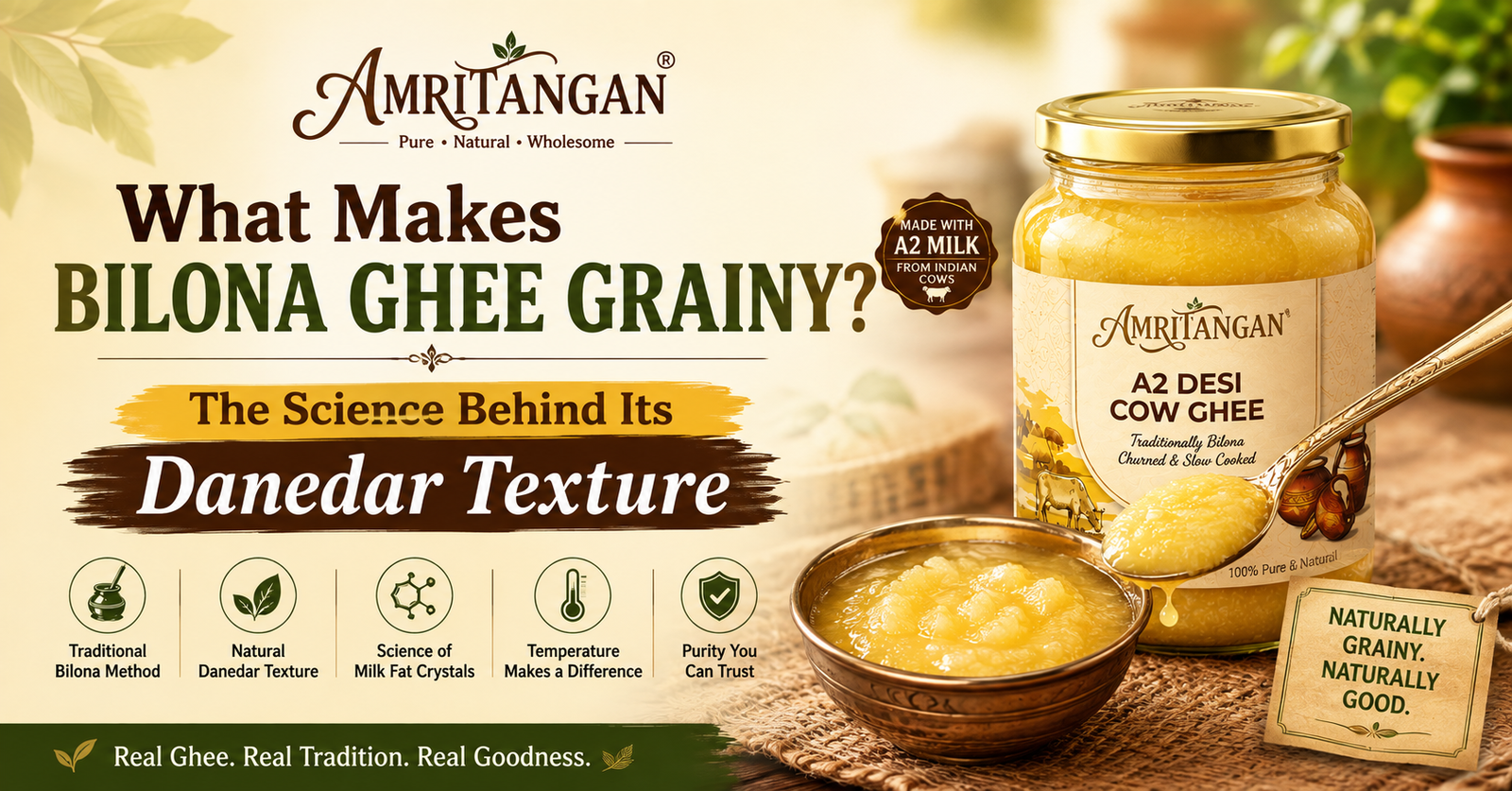
Have you ever opened a jar of traditional ghee and noticed tiny grains or crystals throughout it? If yes, you may have wondered: Why is Bilona Ghee grainy? Is this natural, or does it mean something is wrong with the ghee?
The characteristic danedar texture is one of the things people often associate with traditionally prepared ghee. However, texture can vary depending on several factors, including the milk fat, preparation process, cooling conditions and storage temperature.
Ghee is not always supposed to look perfectly smooth. In fact, natural fat crystallization can create small grains as ghee cools and solidifies. This is why the same ghee may look grainier in cooler conditions and smoother when warm.
But there is an important distinction to understand: grainy texture alone cannot prove that ghee is pure or authentic. To evaluate the quality of ghee, you should consider its ingredients, sourcing, preparation method, labeling and overall transparency.
So, what exactly creates those tiny grains? Let’s understand the science and traditional process behind danedar Bilona Ghee.
Grainy ghee, commonly called danedar ghee, is ghee that develops small visible grains or crystals within its otherwise solid or semi-solid texture.
Instead of appearing completely uniform and smooth, you may notice:
This happens because ghee is primarily composed of milk fat. When the fat cools and solidifies, different types of fat can crystallize at different rates.
The result can be a texture that ranges from very fine and creamy to visibly grainy.
Yes, a grainy texture can be completely natural.
However, not every grainy ghee is automatically pure, and not every smooth ghee is automatically adulterated. Texture is influenced by temperature and processing conditions, so it should be considered alongside other quality indicators.
According to FSSAI’s standards, ghee is a milk-fat product produced through processes that result in almost total removal of water and milk solids-not-fat; the standard specifies a maximum moisture level of 0.5% and minimum milk fat of 99.5%.
This is the main question.
The grainy texture of Bilona Ghee can develop because of fat crystallization during cooling. Several factors can influence how those crystals form and how noticeable they become.
Let’s look at them individually.
Milk fat isn’t made up of just one type of fat. It contains a mixture of different fatty acids and triglycerides.
These components don’t all solidify at exactly the same temperature.
As ghee cools, some fat components begin forming crystals before others. The arrangement and size of these crystals influence the final texture.
This is one reason two batches of traditionally prepared ghee may not look exactly identical.
Natural food products can show some variation from batch to batch.
The preparation method also matters.
The traditional Bilona process generally follows this sequence:
Milk → Curd → Churning → Butter → Slow Heating → Ghee
Instead of directly separating cream and immediately processing it into ghee, the traditional method involves converting milk into curd and then churning the curd to obtain butter.
That butter is subsequently heated slowly to make ghee.
If you’d like to understand this process in greater detail, read our guide on the traditional Bilona method.
The process affects the characteristics of the final ghee, including its aroma, flavour and physical structure.
Traditional ghee-making involves heating butter until the water is removed and the milk solids separate.
The heating process has an important role in developing ghee’s characteristic aroma and flavour.
Once the ghee has been clarified and strained, it begins to cool. This cooling stage is particularly important for the development of its final texture.
This is where the danedar texture really develops.
As liquid ghee cools, its fat molecules begin to organize themselves into crystals.
Depending on the composition of the fat and the cooling conditions, these crystals may be:
The more noticeable these crystals are, the grainier the ghee may appear.
So when someone asks, “Why does Bilona Ghee become grainy?”, the simple answer is:
Because the milk fat naturally crystallizes as the ghee cools, creating tiny fat crystals that can give it a danedar texture.
The Bilona method can contribute to the characteristics of traditionally prepared ghee, but it would be inaccurate to say that every Bilona Ghee must have exactly the same grainy texture.
The traditional process involves curd formation, churning, butter separation and slow clarification. Each stage can influence the final physical characteristics of the ghee.
At the same time, factors such as:
can all influence the final texture.
That’s why natural Bilona Ghee can have some variation from one batch to another.
This is one of the biggest misconceptions surrounding ghee.
You may hear people say:
“The more grainy the ghee, the purer it is.”
That’s not a reliable rule.
A smooth ghee isn’t automatically fake, and a grainy ghee isn’t automatically authentic.
Here’s a simple comparison:
| Feature | Grainy Ghee | Smooth Ghee |
| Texture | Danedar/crystalline | Uniform/smooth |
| Can occur naturally? | Yes | Yes |
| Influenced by temperature? | Yes | Yes |
| Automatically proves purity? | No | No |
| Can change after heating? | Yes | Yes |
| Can change during storage? | Yes | Yes |
If you’re trying to determine whether a ghee is genuine, look beyond texture.
You can learn more about what to check in our guide to 10 signs of pure desi ghee.
Temperature has a major effect on ghee’s texture.
As temperature rises, the fat crystals begin melting.
The ghee becomes:
Firm → Soft → Liquid
At this stage, the visible grains may disappear.
As the temperature drops, the fat begins to solidify again.
You may see:
Liquid → Semi-solid → Firm/Grainy
This is completely normal.
Imagine a jar of ghee during summer.
In the afternoon, the ghee may become soft or partially liquid.
At night, when the temperature falls, it may solidify again and develop a more noticeable grainy texture.
This doesn’t mean the ghee has suddenly changed in quality. Its physical state has changed because of temperature.
You may notice that one jar has very fine grains while another appears slightly more coarse.
Natural variation can happen.
Some factors that may influence grain size include:
The composition of milk fat can vary naturally.
How quickly or slowly ghee cools can affect crystal formation.
Temperature fluctuations can alter the appearance and consistency of the fat crystals.
Heating and clarification conditions can also influence the final texture.
Traditional food products don’t necessarily have the exact same physical appearance in every batch.
Therefore, a slightly different texture doesn’t automatically indicate a difference in quality.
No—not by itself.
This is an important point for consumers.
Graininess can be a natural characteristic of ghee, but you should never use texture as the only method of checking purity.
When buying ghee, consider:
FSSAI maintains standards for ghee and other milk-fat products, including composition and quality requirements.
In other words, natural appearance is one observation—not a complete authenticity test.
You may have noticed that your ghee looks grainy one day and smooth the next.
There’s a simple reason: temperature changes the physical structure of fat.
For example:
Cold ghee → firm and grainy
Room-temperature ghee → softer
Warm ghee → smooth and liquid
Cooling again → solidification and possible crystal formation
So if your Bilona Ghee becomes smooth after heating, that doesn’t mean it has lost its traditional characteristics.
Once it cools again, some crystal structure may return.
Yes.
Refrigeration makes ghee much firmer because the fat solidifies at lower temperatures. The texture may therefore appear different from ghee kept at room temperature.
If you want to understand the best way to store ghee, including whether refrigeration is necessary, read our guide on whether A2 Bilona Ghee needs refrigeration.
The important thing to remember is:
A change in texture caused by temperature does not automatically mean the ghee has spoiled.
Always follow the storage instructions and best-before date provided with your product.
Instead of judging ghee only by how grainy it looks, consider the complete product.
Look for clear and transparent ingredient information.
If a product claims to be Bilona Ghee, the brand should be able to explain what that means and how the product is prepared.
Good packaging should protect the ghee from contamination, moisture and unnecessary exposure.
Look for required food labeling and manufacturer details.
Traditionally prepared ghee can have a distinctive rich, cooked-butter aroma. However, sensory characteristics should again be considered alongside other information rather than used as a standalone purity test.
A trustworthy food brand should be willing to explain its sourcing and production process.
Let’s clear up a few common myths.
Fact: Graininess can occur naturally, but it cannot independently establish purity.
Fact: Ghee can become smooth when warmed or depending on how it crystallizes during cooling.
Fact: Natural products can show variations in texture and appearance.
Fact: Ghee naturally melts when heated and solidifies when cooled.
Fact: Grain size is influenced by several factors and shouldn’t be treated as a quality score.
At Amritangan, our focus is on preserving the traditional character of A2 Desi Cow Ghee through the Bilona method.
The traditional process involves working with milk, curd, butter and slow clarification rather than simply treating texture as a marketing feature.
This approach helps create the rich aroma, flavour and naturally varying texture that consumers associate with traditionally prepared Bilona Ghee.
One thing worth remembering is that natural ghee doesn’t have to look identical in every batch. Factors such as milk composition and temperature can influence its final appearance.
That’s why we believe consumers should look at the complete story behind the product, rather than judging ghee only by whether it looks grainy or smooth.
And if you’re interested in understanding whether traditionally prepared ghee justifies its higher price, you can also read our detailed guide on whether A2 Bilona Ghee is worth the price.
Read more – Does A2 Bilona Ghee Need Refrigeration? Storage Myths Explained
Proper storage helps maintain the quality and freshness of ghee.
Follow these simple practices:
Remember that temperature can change the texture. Grainy, soft and liquid states can all occur naturally depending on the surrounding temperature.
Not by itself. Grainy texture can occur naturally because of fat crystallization, but texture alone cannot confirm purity.
Bilona Ghee can become grainy when its milk fat crystallizes during cooling. Milk-fat composition, processing and temperature can influence the appearance and size of the grains.
Not necessarily. Grainy and smooth textures can both occur naturally. The texture alone doesn’t determine the quality or purity of ghee.
The natural crystallization of milk fat during cooling can give A2 Bilona Ghee a danedar texture. Processing and temperature also influence the final appearance.
Heating melts the fat crystals, causing the visible grainy structure to disappear. As the ghee cools again, crystals can form once more.
Refrigeration makes ghee firmer and can make its fat crystals more noticeable. Texture can therefore change when ghee is refrigerated.
Yes. Pure ghee can have different textures depending on its composition, preparation and temperature. Smoothness alone doesn’t indicate adulteration.
Grain size can vary because of differences in milk-fat composition, cooling rate, processing conditions and storage temperature.
No. Graininess can occur in traditionally prepared ghee, but texture alone cannot establish whether a product is homemade.
Keep it tightly covered in a clean, dry environment, away from moisture and direct sunlight, and follow the storage instructions provided by the manufacturer.
So, what makes Bilona Ghee grainy?
The answer comes down largely to the natural behaviour of milk fat.
As ghee cools, its fat components can crystallize and create the small grains associated with danedar ghee. The Bilona preparation method, milk-fat composition, heating process, cooling conditions and storage temperature can all influence the final texture.
That’s why one jar may appear finely grainy while another may look smoother.
The most important takeaway is this:
Grainy texture can be a natural characteristic of ghee, but it should not be treated as the only proof of purity or authenticity.
When choosing A2 Bilona Ghee, look at the entire product—its ingredients, sourcing, preparation method, labeling, packaging and the transparency of the brand behind it.
At Amritangan, our aim is to bring the traditional character of A2 Desi Cow Ghee to your kitchen through a carefully followed Bilona process.
Looking for traditionally prepared A2 Bilona Ghee? Explore Amritangan A2 Desi Cow Ghee and experience the rich aroma, flavour and naturally varying character of traditionally crafted ghee.
No account yet?
Create an AccountNeed help? Our team is just a message away