Rakhi Special Sale Live Use "RAKHI10" Coupon Code
Rakhi Special Sale Live Use "RAKHI10" Coupon Code

Have you ever tasted homemade ghee and noticed that it has a different aroma, flavour, or texture compared with store-bought ghee?
Even though both are called ghee, they may not taste exactly the same. The difference can come from several factors, including the type of milk used, the way the ghee is prepared, heating time, freshness, and storage conditions.
Homemade ghee is often made in small batches using traditional methods, while store-bought ghee is generally produced on a larger scale with a focus on consistency. Understanding these differences can help you appreciate why ghee can taste different from one batch or brand to another.
The biggest difference is usually the way the ghee is made and the ingredients used.
Homemade ghee is commonly prepared from butter made from milk at home. Depending on the household, the butter may be made by churning curd or cream before it is slowly heated to make ghee.
Store-bought ghee, on the other hand, is manufactured commercially. Different brands may use different milk sources, production methods, heating conditions, and storage processes.
| Factor | Homemade Ghee | Store-Bought Ghee |
|---|---|---|
| Milk source | Depends on the milk used at home | Depends on the manufacturer |
| Production | Usually small-batch | Usually larger-scale |
| Aroma | Can vary from batch to batch | Usually more consistent |
| Taste | Can have a distinct homemade flavour | Depends on the brand and process |
| Texture | May naturally vary | Often more uniform |
| Freshness | Depends on when it was prepared | Depends on production and storage |
This does not mean that homemade ghee is always better or that store-bought ghee is always inferior. The actual quality and taste depend on how the ghee is made.
Traditional ghee preparation can involve several steps.
A simple traditional process looks like this:
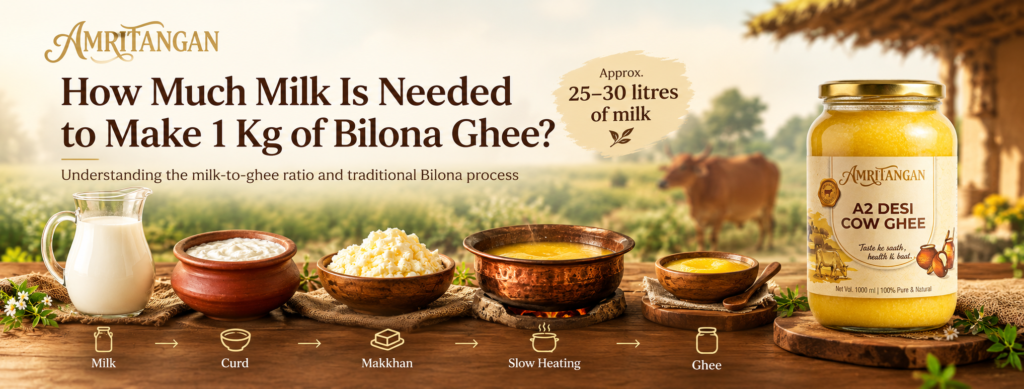
Milk → Curd → Churning → Makkhan → Heating → Ghee
First, milk is converted into curd. The curd can then be churned to separate the butter, commonly called makkhan. The butter is heated until its water content evaporates and the milk solids separate.
What remains is clarified butter, or ghee.
The exact method can vary between households. The temperature, cooking time, type of milk, and amount of butter used can all influence the final taste and aroma.
For readers interested in the traditional process, you can also learn more about what the Bilona method is and how it is traditionally used to make ghee.
One of the first things people notice about homemade ghee is its aroma.
Several factors can contribute to this.
The milk used to make butter can influence the final characteristics of ghee.
Milk composition can vary depending on factors such as the animal, feed, season, and source of the milk. These differences can influence the flavour and aroma of the finished ghee.
Heating is an important part of ghee making.
When butter is heated, its water evaporates and the milk solids separate. The way the butter is heated—including the temperature and cooking time—can affect the final aroma and flavour.
Slow cooking can produce the characteristic rich, cooked aroma associated with traditionally prepared ghee.
Freshly prepared ghee may have a more noticeable aroma than ghee that has been stored for a longer period.
Storage conditions can also affect how the aroma develops over time.
Homemade ghee is often made in relatively small quantities.
Because of this, every batch can be slightly different. One batch may have a stronger aroma, while another may taste milder depending on the milk and preparation process.
Commercial ghee is produced with the goal of maintaining consistency across batches.
Large-scale production can involve controlled processing, heating, filtration, packaging, and storage. Different manufacturers may also follow different recipes and production methods.
As a result, the taste of store-bought ghee can vary from one brand to another.
Some packaged ghees may have a mild aroma, while others may have a stronger and more traditional flavour. The difference does not come simply from whether the ghee is packaged or homemade—it depends on the ingredients and manufacturing process.
Yes, the preparation method can influence the final characteristics of ghee.
Traditional Bilona-style preparation generally involves converting milk into curd, churning the curd to obtain butter, and then heating the butter to make ghee.
Other ghee-making processes may use different starting ingredients or production methods.
These differences can affect the final aroma, texture, colour, and flavour.
If you want to understand another important difference between traditional and commercially produced ghee, read our guide on Bilona Ghee vs Commercial Ghee.
Ghee is known for its rich and distinctive flavour.
During heating, the water in butter evaporates while the milk solids separate. The controlled heating of these milk solids contributes to the characteristic cooked and nutty notes that many people associate with ghee.
The final flavour can vary depending on:
This is one reason two different ghees can have noticeably different flavours.
Not necessarily.
A strong aroma by itself is not proof that ghee is pure or of higher quality.
Likewise, a mild aroma does not automatically mean that ghee is poor quality.
Taste and aroma are influenced by many factors, including milk composition, preparation method, heating, freshness, and storage.
When choosing ghee, it is better to look at the complete picture rather than judging it only by smell or colour.
You can also read our guide on desi cow ghee benefits to learn more about the characteristics and traditional uses associated with desi cow ghee.
If you make ghee at home, you may notice that it does not taste exactly the same every time.
This is completely understandable because homemade preparation can involve natural variations.
Some common factors include:
For example, if the milk used in one batch has a different composition from another batch, the resulting ghee may also have slightly different characteristics.
Commercial manufacturers generally use controlled processes to reduce these variations and produce a more consistent product.
Read more: Does the Container Affect Ghee Quality? Glass vs Plastic vs Steel
If you want to compare homemade and store-bought ghee, try tasting them under similar conditions.
Take a small, similar amount of each ghee.
Smell each ghee before tasting it. Notice whether the aroma is mild, rich, nutty, or more pronounced.
Temperature can affect how ghee feels and tastes, so try to compare both at similar temperatures.
Pay attention to how smooth, rich, or light each ghee feels.
Some ghees may leave a stronger buttery or nutty aftertaste, while others may have a milder finish.
This simple comparison can help you understand your own taste preferences without assuming that one type of ghee is automatically better than another.
There is no single answer for everyone.
Your choice can depend on what matters most to you, such as:
If you enjoy making ghee at home and have access to suitable milk and time, homemade ghee can be a traditional option.
For those who prefer convenience, packaged ghee can be easier to purchase and use regularly. In that case, checking the product information and understanding how the ghee is made can help you make an informed choice.
Homemade ghee can taste different from store-bought ghee because ghee is influenced by much more than just the final ingredient.
The milk source, preparation method, heating process, freshness, and storage conditions can all contribute to its flavour and aroma.
Homemade ghee may have natural batch-to-batch variations, while commercially produced ghee is generally made with processes designed for greater consistency.
So, if two ghees taste different, that does not automatically mean one is pure and the other is not. Understanding how each ghee is made is a much better way to appreciate the differences.
At Amritangan, our focus is on traditional food practices and bringing thoughtfully prepared products from farm to home. If you are exploring traditionally prepared ghee, take a look at our A2 Desi Cow Ghee and learn more about its preparation and characteristics.
For more Updates – Amritangan Farms
The difference can come from the milk source, preparation method, heating process, freshness, and storage conditions.
Homemade ghee can have a stronger aroma because of the type of milk used, cooking method, heating conditions, and freshness.
Not necessarily. Taste is subjective and can vary according to the preparation method and individual preference.
The characteristic nutty flavour can develop during the heating of butter as water evaporates and milk solids separate.
Yes. Differences in milk composition and source can influence the flavour and aroma of the resulting ghee.
It can. The Bilona-style process involves curdling and churning before the butter is heated into ghee, and this traditional preparation can contribute to different flavour and aroma characteristics.
Yes. Storage conditions and length of storage can influence the aroma, flavour, and texture of ghee.
No. Aroma alone cannot establish the purity or quality of ghee. It is better to consider the ingredients, preparation method, source, and other available product information.
No account yet?
Create an AccountNeed help? Our team is just a message away