Rakhi Special Sale Live Use "RAKHI10" Coupon Code
Rakhi Special Sale Live Use "RAKHI10" Coupon Code
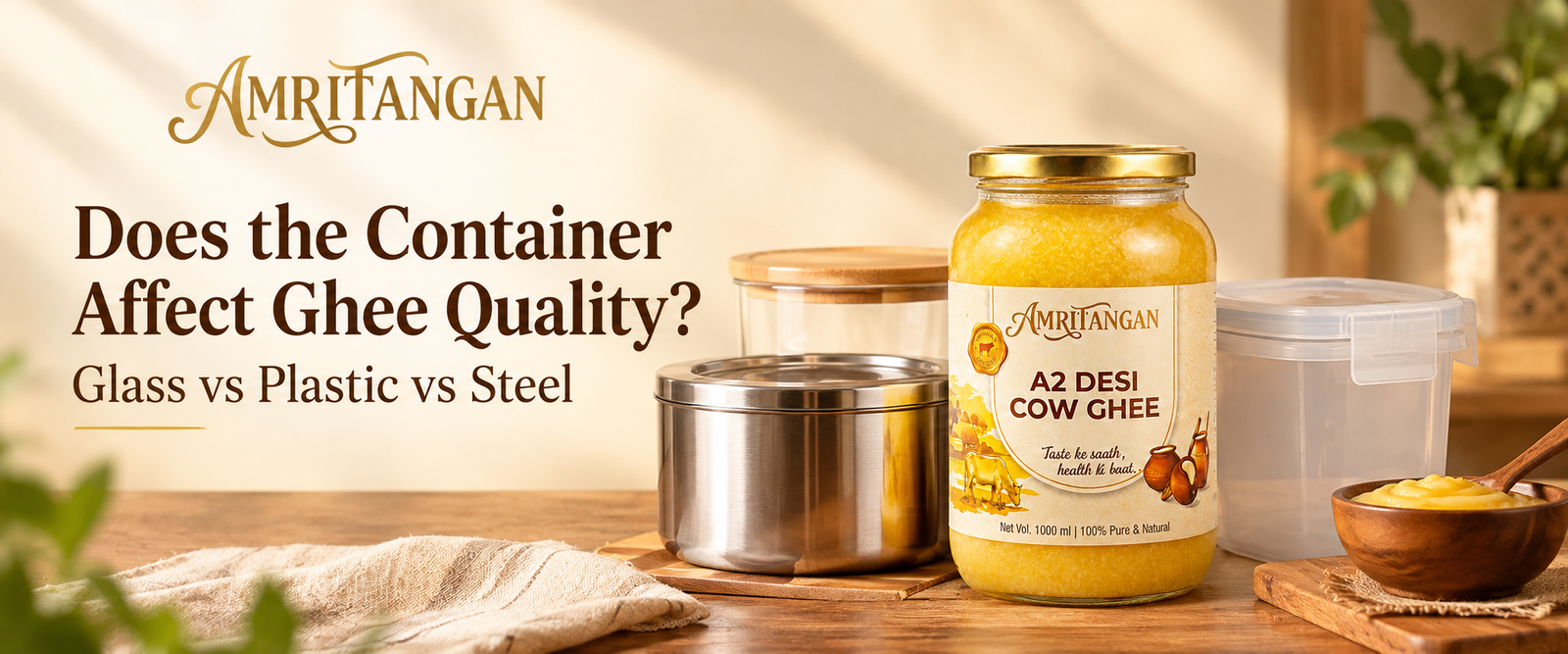
When you buy a good-quality jar of ghee, you probably think about the milk source, preparation method, taste, aroma and purity. But there is another simple question that is often overlooked:
Does the container used to store ghee affect its quality?
The answer is that the container does matter, especially when it comes to protecting ghee from moisture, contamination, unwanted odours, heat and unnecessary exposure to air.
Glass, stainless steel and food-grade plastic are all used for food storage, but they have different advantages and practical considerations.
So, which is the best container for storing ghee?
Let’s compare glass vs plastic vs steel and understand what actually matters when storing ghee at home.
Ghee is more stable than many other dairy products because most of its moisture is removed during preparation. However, proper storage is still important for maintaining its aroma, flavour and overall quality.
The container can affect how easily ghee is exposed to:
A good storage container should therefore be clean, dry, suitable for food contact and capable of being properly closed.
But remember: the container alone does not determine the quality or purity of ghee.
The ingredients, manufacturing process, hygiene, packaging and storage conditions all matter.
If you are interested in what to check before buying ghee, read our latest guide: Original Ghee vs Local Ghee: 10 Differences You Should Check Before Buying.
Glass jars are a common choice for storing premium food products, including ghee.
One of the main advantages of glass is that it is generally considered a suitable food-contact material and does not easily absorb food smells.
Ghee naturally has a distinctive buttery, dairy or mildly nutty aroma. A clean glass jar can help keep the product’s original aroma without adding another smell.
Glass is relatively easy to wash and clean thoroughly. This is especially useful when the same container is used repeatedly.
A transparent glass jar lets you see the colour and texture of the ghee without opening the container.
A properly sealed glass container can be a practical option for storing ghee at home
Glass jars are sturdy enough for repeated household use when handled carefully and can be reused when cleaned properly.
Glass has a few practical drawbacks.
Overall, glass is a practical option when you want a durable, easy-to-clean container for ghee.
Stainless steel is another popular choice in Indian kitchens.
Many households already use steel containers for storing everyday foods, and a suitable food-grade stainless steel container can also be used for ghee.
Steel containers are less likely to break if dropped.
Unlike transparent glass, an opaque steel container blocks direct light.
Steel containers are lightweight enough for everyday kitchen use and are available in many sizes.
A good-quality food-grade stainless steel container can be washed and reused many times.
Not every metal container should automatically be considered suitable for every food.
Choose a container that is intended for food storage and keep it:
The same rule applies here as with any food-storage container: cleanliness and proper handling are important.
Yes, but there is an important distinction:
Not all plastic containers are the same.
If plastic is used for storing food, it should be appropriate for food contact and suitable for the intended use.
A good-quality food-grade plastic container can be convenient because it is:
However, plastic quality and intended use matter.
Avoid storing ghee in:
It is also important not to assume that plastic automatically makes ghee unsafe. The type and intended food-contact use of the material matter.
Let’s compare the three options.
| Feature | Glass | Stainless Steel | Food-Grade Plastic |
| Food storage suitability | Suitable when intended for food use | Suitable when food-grade | Suitable when intended for food use |
| Odour absorption | Generally low | Generally low | Depends on material and use |
| Light protection | Low if transparent | High | Depends on container |
| Durability | Can break | Very durable | Lightweight and durable |
| Weight | Heavy | Medium | Light |
| Cleaning | Easy | Easy | Depends on design |
| Visibility | Easy to see contents | Cannot see contents | Usually visible |
| Long-term household use | Practical | Practical | Depends on material and use |
| Travel convenience | Moderate | Moderate | High |
There is no single container that is perfect for every situation.
The best choice depends on how you store and use your ghee.
It can influence the storage environment, but the material itself should not be treated as the only factor responsible for changes in taste or smell.
Ghee can naturally have a noticeable aroma. Its smell may also become stronger when heated.
However, unwanted smells can become a concern when food is stored improperly.
For example, if a container:
the stored ghee may be exposed to those conditions.
This is why a clean, dry and properly closed container is important.
If you notice that your ghee smells different after heating, read our guide: Why Does Ghee Smell Different After Heating? Here’s Why.
The container can contribute to proper storage, but it does not determine shelf life by itself.
Other factors are also important:
Excessive heat can affect the quality and aroma of ghee over time.
Water entering the container can create storage problems.
Keeping the jar properly closed helps reduce unnecessary exposure to air.
Direct sunlight and excessive heat should be avoided during storage.
Using a clean, dry spoon every time helps prevent moisture and food particles from entering the jar.
For a detailed guide to storage and refrigeration, read Does A2 Bilona Ghee Need Refrigeration? Storage Myths Explained.
There is no need to make this more complicated than it is.
For everyday household storage, glass and suitable stainless steel containers are both practical choices.
Food-grade plastic can also be useful when lightweight and convenient storage is important.
Your choice can depend on how you use the ghee.
Glass or stainless steel can both work well.
Choose a container that is easy to clean, easy to open and properly sealed.
A suitable food-grade lightweight container can be more convenient.
Glass can be a practical choice because it is easy to clean, allows you to see the product and can help maintain the original aroma when properly sealed.
At Amritangan, our A2 Desi Cow Bilona Ghee is packed in premium glass jars as part of our focus on quality packaging and convenient storage.
Regardless of the container you choose, follow these simple storage habits.
Never use a wet spoon to take ghee from the jar.
Even small amounts of moisture should be avoided.
Close the container properly after every use.
This helps protect the ghee from unnecessary exposure to air, dust and surrounding smells.
Store the jar in a cool, dry place away from direct sunlight.
If you are transferring ghee into another container, make sure it has been properly washed and is completely dry before adding the ghee.
Do not put food, crumbs or used spoons directly into the ghee.
Always follow the manufacturer’s storage instructions and check the best-before date printed on the package.
This is one of the easiest mistakes to avoid.
Always use a clean and completely dry spoon.
Repeated exposure to excessive heat is unnecessary.
Choose a cooler storage location.
An open jar is more exposed to dust, moisture and surrounding odours.
If a reused container still smells strongly of another food, clean it thoroughly before using it for ghee.
Always choose plastic intended for food contact rather than using an unknown container.
The container should be completely dry before ghee is added.
Yes.
If you prefer to use a steel container in your kitchen, you can transfer ghee from a glass jar.
Just make sure the new container is:
There is no need to transfer ghee simply because the container material is different. If the original packaging is suitable and convenient, keeping the ghee in its original container can also be a simple option.
No.
Changing the container does not make ghee more pure.
Purity depends on factors such as the ingredients, preparation process, manufacturing practices and absence of unwanted additions.
The container’s primary role is to help protect the product during storage.
If you’re comparing ghee before purchasing, don’t judge it only by its packaging. Check the ingredient information, milk source, manufacturing method, batch information and quality documentation.
For more practical buying tips, read our latest article: Original Ghee vs Local Ghee: 10 Differences You Should Check Before Buying.
Read more: Original Ghee vs Local Ghee
Glass and suitable stainless steel containers are both practical choices for household ghee storage. Food-grade plastic can also be useful depending on the intended use.
Glass has advantages such as easy cleaning, low odour absorption and durability when handled carefully. Food-grade plastic can be useful when lightweight storage is more important.
Yes. A clean, dry and suitable food-grade stainless steel container can be used for storing ghee.
Yes, provided the container is appropriate for food contact and suitable for the intended use.
Ghee has a naturally noticeable aroma, but proper storage is still important. A clean container with a properly closed lid helps reduce exposure to unwanted smells.
A properly closed container is recommended to protect ghee from unnecessary exposure to air, moisture, dust and surrounding smells.
Yes. Make sure the steel container is food-grade, clean and completely dry before transferring the ghee.
The container can contribute to proper storage, but shelf life also depends on temperature, moisture, handling, packaging, manufacturing practices and the product’s stated best-before date.
Follow Us on Instagram: Amritanganfarms
So, does the container affect ghee quality?
Yes, storage conditions and the suitability of the container matter, but the container is only one part of the picture.
Glass, stainless steel and appropriate food-grade plastic can all have practical uses.
For everyday home storage, focus on the basics:
At Amritangan, we use premium glass jars for our A2 Desi Cow Bilona Ghee, keeping the focus on careful packaging along with traditional preparation.
Because when it comes to ghee, good storage is about protecting the quality you started with.
No account yet?
Create an AccountNeed help? Our team is just a message away