Rakhi Special Sale Live Use "RAKHI10" Coupon Code
Rakhi Special Sale Live Use "RAKHI10" Coupon Code
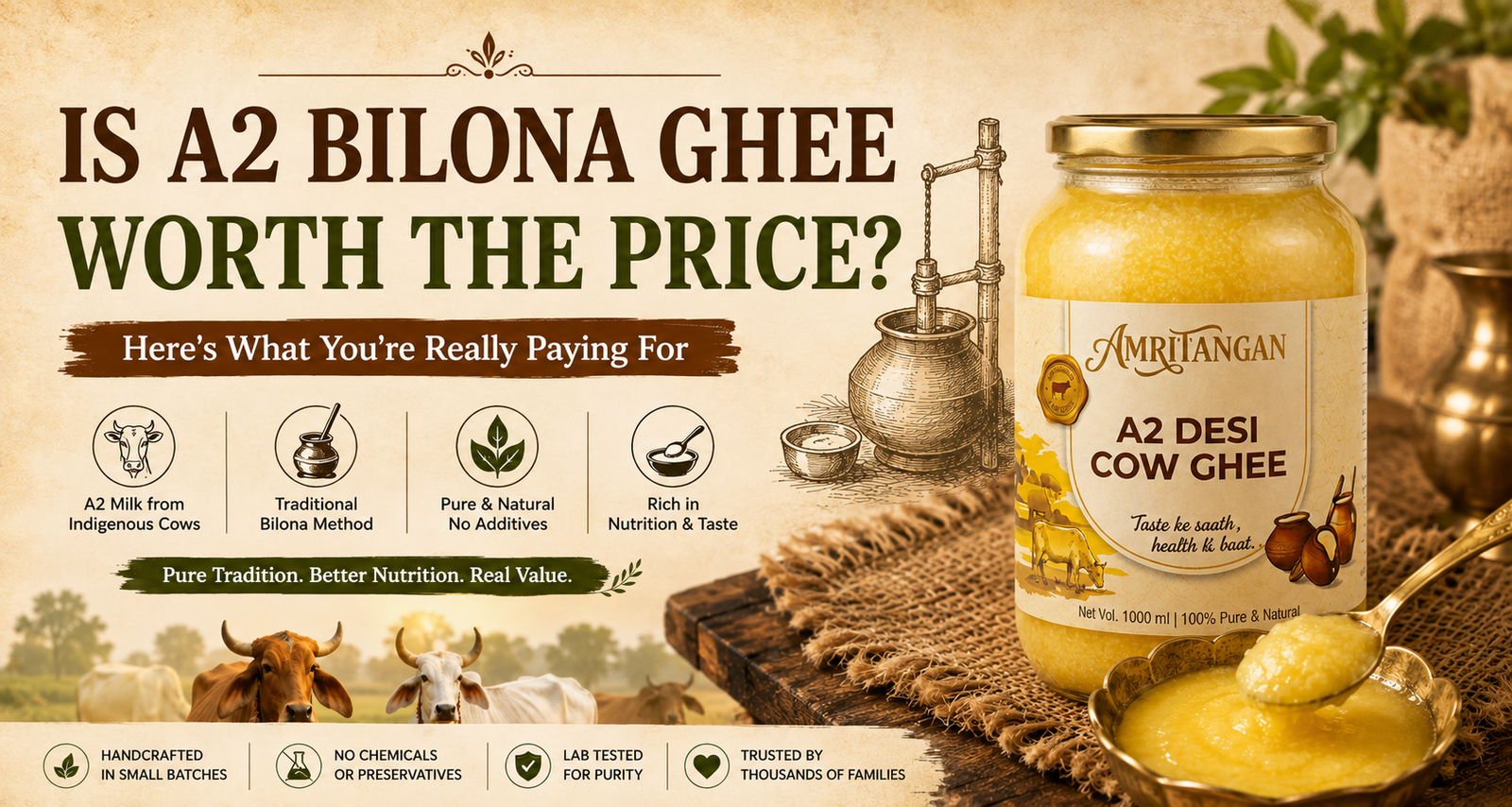
If you’ve ever compared different ghee brands online or in stores, you’ve probably noticed that A2 Bilona Ghee is significantly more expensive than regular ghee. While standard ghee may cost much less, authentic A2 Bilona Ghee often carries a premium price tag. This naturally raises an important question—is A2 Bilona Ghee really worth the price, or are you simply paying for branding?
The answer lies in understanding how authentic Bilona Ghee is made, the quality of the milk used, and the traditional methods involved. Unlike mass-produced ghee that is manufactured using industrial processes, genuine Bilona Ghee follows an age-old preparation technique that prioritizes purity, nutrition, and taste over speed and volume.
From sourcing milk from indigenous Indian cows to preparing curd, hand-churning butter, and slowly simmering it into golden ghee, every step requires time, patience, and skilled craftsmanship. This traditional process is one of the biggest reasons why authentic Bilona Ghee costs more than commercially produced alternatives.
In this guide, we’ll break down exactly what you’re paying for, why the traditional Bilona process matters, and whether investing in premium A2 Bilona Ghee makes sense for your family.
At first glance, two jars of ghee may look similar. However, their production methods, ingredients, and nutritional value can be completely different.
The higher price of authentic A2 Bilona Ghee isn’t because of fancy packaging or marketing. It reflects the quality of the raw ingredients, traditional preparation methods, lower production volume, and the time-intensive craftsmanship involved.
Here are the biggest factors behind its premium pricing.
Authentic Bilona Ghee is prepared using milk from native Indian cow breeds such as:
These breeds naturally produce A2 beta-casein milk, which many consumers prefer because it is less processed and aligns with traditional Indian dairy practices.
Maintaining indigenous cows is also more expensive than large-scale commercial dairy farming. Their milk production is generally lower, but the emphasis is on quality rather than quantity.
As a result, the raw material itself costs significantly more than the milk commonly used for industrial ghee production.
One of the biggest differences between authentic Bilona Ghee and commercial ghee lies in the starting ingredient.
Most factory-made ghee is produced directly from cream because it is faster and more economical.
Traditional Bilona Ghee, however, follows a completely different process:
Fresh Milk → Curd → Butter → Ghee
This method requires several additional steps before the final product is ready.
Preparing fresh curd, allowing natural fermentation, extracting butter through churning, and then slowly heating the butter all contribute to higher production costs and longer preparation times.
Unlike industrial production lines that process thousands of kilograms daily, the Bilona method is intentionally slow.
Each batch involves:
This entire process can take several days to complete.
Instead of focusing on speed, the Bilona method prioritizes authenticity, traditional craftsmanship, and nutrient preservation.
That extra time and manual effort naturally increase production costs.
Another major reason behind the premium pricing is the amount of milk required.
Producing just 1 kilogram of authentic A2 Bilona Ghee typically requires around 25–30 litres of fresh A2 milk, depending on the breed, season, and fat content.
Since a large quantity of milk results in a relatively small amount of ghee, the overall cost of production rises considerably.
This low yield is one of the defining characteristics of traditionally prepared Bilona Ghee.
When purchasing premium A2 Bilona Ghee, you’re not simply buying clarified butter. You’re investing in a product made through a careful and traditional process that emphasizes quality over mass production.
Let’s look at what contributes to its value.
Everything begins with high-quality milk from indigenous Indian cows.
Unlike mass-market dairy operations that prioritize volume, traditional farms focus on maintaining native breeds and ensuring ethical animal care.
The quality of the milk directly influences the aroma, texture, nutritional profile, and overall taste of the finished ghee.
Higher-quality milk naturally results in a higher-quality product.
The Bilona method has been practiced in Indian households for generations.
Instead of extracting fat directly from cream, curd is churned to obtain fresh white butter.
This traditional technique is believed to preserve the natural richness and authentic flavor that many families associate with homemade ghee.
It also requires significantly more time and manual effort than industrial alternatives.
Unlike commercial factories that produce massive quantities every day, authentic Bilona Ghee is often prepared in smaller batches.
Small-batch production allows better quality control at every stage, from milk collection to slow cooking and final packaging.
This approach helps maintain consistency while preserving the traditional characteristics of genuine Bilona Ghee.
Authentic A2 Bilona Ghee should contain just one ingredient—pure cow butter.
It doesn’t require:
The result is a clean, natural product with a rich aroma and authentic taste.
Consumers looking for minimally processed foods often value this level of purity.
Anyone who has experienced authentic Bilona Ghee often notices its distinctive nutty aroma and rich flavour.
Because it is slowly simmered over a controlled flame, the ghee develops a naturally deep golden colour and characteristic grainy texture.
These qualities are difficult to replicate through industrial processing.
For many families, this traditional taste alone justifies the higher price.
One of the biggest reasons A2 Bilona Ghee commands a premium price is the traditional process used to prepare it. Unlike modern industrial methods, the Bilona technique has been followed in Indian households for centuries and focuses on patience rather than speed.
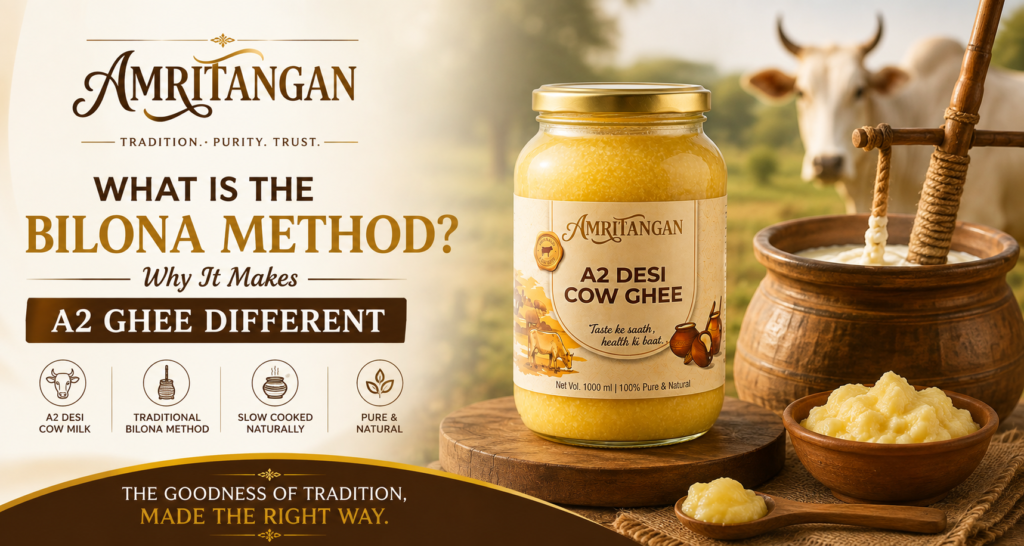
The process begins with fresh A2 milk collected from indigenous Indian cows. Instead of separating cream immediately, the milk is first boiled and then naturally cooled. A starter culture is added to transform the milk into fresh curd through overnight fermentation.
The curd is then churned using a traditional Bilona (wooden churner) to separate fresh white butter from buttermilk. This butter is carefully collected and slow-cooked over a low flame until the moisture evaporates, leaving behind pure, aromatic golden ghee.
Unlike industrial production, no shortcuts are taken, and no chemicals or preservatives are added. The result is a rich, grainy-textured ghee with an authentic aroma and flavour that reflects traditional Indian craftsmanship.
Many people assume that all ghee is the same because the final product looks similar. However, the method of preparation makes a significant difference in terms of taste, aroma, texture, and overall quality.
Commercial ghee is designed for large-scale production. Manufacturers typically separate cream from milk and heat it directly to produce ghee quickly and efficiently. This process allows factories to produce large quantities at a lower cost.
Authentic A2 Bilona Ghee, on the other hand, follows the traditional curd-churning method. It takes considerably more time and effort but produces a rich, aromatic ghee that reflects centuries-old Indian dairy traditions.
| Feature | A2 Bilona Ghee | Commercial Ghee |
| Milk Source | Indigenous A2 Cow Milk | Mixed or regular milk |
| Preparation Method | Traditional Bilona (Curd → Butter → Ghee) | Cream-Based Industrial Process |
| Production | Small Batch | Mass Production |
| Churning | Traditional Bilona Churning | Mechanical Processing |
| Processing Time | Several Days | Few Hours |
| Preservatives | Generally None | May vary by brand |
| Aroma | Rich & Nutty | Mild |
| Texture | Naturally Grainy | Smooth |
| Focus | Quality & Tradition | High Volume Production |
Although both products are technically ghee, the ingredients, preparation techniques, and overall experience are quite different.
Internal Link Suggestion: Read our detailed comparison: Bilona Ghee vs Commercial Ghee: Which One Should You Choose?
One of the biggest reasons behind the premium price of A2 Bilona Ghee is the amount of milk required.
Unlike commercial production, where cream is extracted directly, traditional Bilona Ghee starts with fresh whole milk.
The journey looks like this:
Fresh A2 Milk → Curd → Butter → Slow-Cooked Ghee
At every stage, the quantity reduces.
Approximately:
This means you’re not just paying for a jar of ghee—you’re paying for a substantial quantity of premium milk, careful processing, and skilled craftsmanship.
This is perhaps the most important question for buyers.
The simple answer is:
Not every expensive ghee is good—but genuine A2 Bilona Ghee justifies its premium price because of how it is produced.
The value lies in:
Instead of focusing solely on price, it’s better to evaluate how the ghee is made.
A cheaper product may still serve everyday cooking needs, but if you’re looking for traditionally prepared, minimally processed ghee, investing in authentic Bilona Ghee can be worthwhile.
When prepared using traditional methods and quality ingredients, A2 Bilona Ghee offers several advantages.
The slow-cooking process develops a naturally deep aroma and rich taste that enhances everyday meals.
Whether spread over rotis, drizzled on dal, or added to khichdi, a small amount can elevate the overall flavour.
The Bilona process has been used in Indian households for generations.
Choosing traditionally prepared ghee helps preserve this heritage while supporting artisanal production methods.
Authentic Bilona Ghee is made through simple, traditional steps rather than highly industrialized processing.
For consumers who prefer minimally processed foods, this is an important factor.
Ghee naturally contains fat-soluble vitamins such as:
These nutrients are naturally present in milk fat.
Internal Link Suggestion: Learn more in our guide: Health Benefits of A2 Desi Cow Ghee.
Although anyone can enjoy Bilona Ghee, it is especially suitable for people who value quality and traditional foods.
It may be a good choice for:
Parents often look for clean, minimally processed ingredients for everyday meals.
Many households include small amounts of ghee in children’s diets as part of traditional Indian meals.
Traditional diets frequently include ghee because of its rich flavour and versatility.
Bilona Ghee has long been valued in Ayurvedic traditions and is commonly used in various dietary practices.
If you enjoy handcrafted products made using time-tested methods, Bilona Ghee aligns well with those preferences.
Honest brands also acknowledge that premium products aren’t the right fit for everyone.
You may not need premium Bilona Ghee if:
The key is choosing the product that best matches your priorities and budget.
As demand for Bilona Ghee grows, many products use the term “Bilona” without fully following the traditional process.
Here’s a simple checklist to help you identify authentic products.
The label should ideally list only one ingredient:
100% Pure Cow Butter (from A2 Milk)
Look for phrases such as:
Avoid products that only mention “premium ghee” without explaining how they are made.
Authentic Bilona Ghee should specify that it is made from milk obtained from indigenous Indian cow breeds.
Responsible brands usually provide quality reports or purity certifications.
Reliable brands openly share information about:
Transparency builds trust.
At Amritangan, we believe that premium ghee should be rooted in tradition, purity, and transparency.
Our A2 Bilona Ghee is crafted using milk from indigenous Indian cows and follows the authentic Bilona process, where fresh milk is first converted into curd, churned into butter, and then slow-cooked in small batches to preserve its natural richness.
We don’t rely on shortcuts or unnecessary additives. Every jar is prepared with care to deliver the authentic aroma, grainy texture, and rich flavour that families have cherished for generations.
Whether you’re preparing everyday meals or following a traditional lifestyle, Amritangan A2 Bilona Ghee offers a wholesome choice for your kitchen.
You may also find these guides helpful:
Yes, if you’re looking for traditional quality, purity, and authentic preparation, A2 Bilona Ghee is worth the investment. Its higher price reflects the use of milk from indigenous Indian cows, the labor-intensive Bilona method, and small-batch production. Unlike mass-produced ghee, it prioritizes craftsmanship over quantity.
A2 Bilona Ghee costs more because it requires 25–30 litres of fresh A2 milk to produce about 1 kg of ghee. The milk is first turned into curd, then churned into butter using the traditional Bilona method before being slow-cooked into ghee. This multi-step process takes several days and involves significantly more time and labor than commercial production.
Bilona Ghee is valued for its traditional preparation method and minimal processing. Many people choose it for its authentic taste, purity, and handcrafted process. Since dietary needs vary from person to person, it’s always a good idea to consume ghee in moderation as part of a balanced diet.
Typically, 25–30 litres of fresh A2 cow milk are needed to make 1 kilogram of authentic Bilona Ghee. The exact quantity depends on factors such as the cow breed, season, and the natural fat content of the milk.
Yes, many families include A2 Bilona Ghee in their daily meals. It can be enjoyed with rotis, dal, rice, khichdi, or other traditional dishes. As with any fat-rich food, moderation is recommended based on your dietary requirements.
Look for these signs:
Not necessarily. A higher price alone doesn’t guarantee better quality. Always check the milk source, preparation method, ingredient list, and brand transparency before making a purchase. Genuine Bilona Ghee should clearly explain how it is made.
When you first compare prices, A2 Bilona Ghee may seem expensive. However, once you understand the traditional Bilona process, the premium quality of A2 milk, the time required for preparation, and the small-batch craftsmanship involved, the pricing becomes much easier to understand.
Authentic Bilona Ghee isn’t just another cooking ingredient—it’s the result of a centuries-old process that values purity, patience, and tradition. From fresh milk to curd, from hand-churned butter to slow-cooked golden ghee, every step is designed to preserve authenticity rather than maximize production.
If your priority is simply finding the cheapest ghee available, a commercially produced option may suit your needs. But if you’re looking for traditional preparation, high-quality ingredients, rich aroma, and a product crafted with care, investing in authentic A2 Bilona Ghee can be a worthwhile choice.
At Amritangan, we remain committed to preserving the traditional Bilona method while delivering pure, high-quality A2 Bilona Ghee made from the milk of indigenous Indian cows. Every jar reflects our dedication to authenticity, transparency, and the timeless taste of traditional Indian ghee.
Explore Amritangan A2 Bilona Ghee and bring home the richness of traditional craftsmanship, natural purity, and authentic flavour for your family’s everyday meals.
No account yet?
Create an AccountNeed help? Our team is just a message away