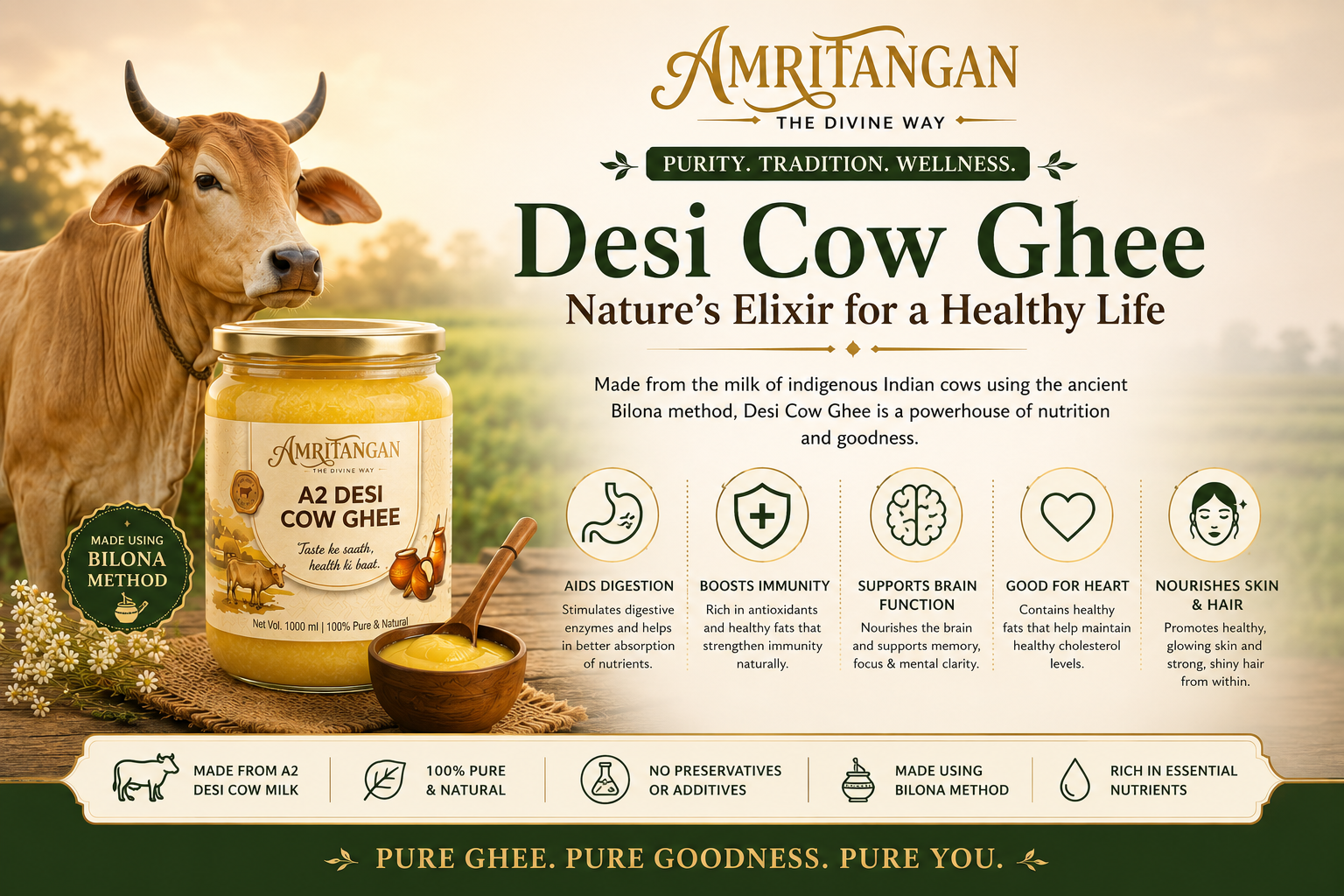
There’s a reason desi cow ghee has sat at the center of Indian kitchens for thousands of years — not merely as a cooking fat, but as something closer to medicine. Our grandmothers weren’t wrong. They just didn’t have the scientific vocabulary to explain what they already knew intuitively.
Ghee made from the milk of indigenous desi cow breeds carries a nutritional profile that commercially processed cooking fats simply cannot replicate. As research into gut health, fat-soluble vitamins, and anti-inflammatory compounds has deepened, desi cow ghee benefits are now being validated by science — not just Ayurveda.
This article breaks down what makes pure desi cow ghee different, what research says about its health effects, how much is appropriate to consume daily, and what to actually look for when buying it.
What Is Desi Cow Ghee?
Ghee, at its most basic, is clarified butter — butter from which water and milk solids have been removed through slow heating, leaving behind pure golden fat. But that single-line definition misses almost everything that matters.
Desi cow ghee is made specifically from the milk of indigenous Indian breeds — Gir, Sahiwal, Rathi, Tharparkar, Kankrej — rather than crossbred or Jersey cows. These breeds are valued because their milk contains the A2 beta-casein protein, which is structurally different from the A1 beta-casein found in most Western hybrid breeds.
The Food Safety and Standards Authority of India (FSSAI) defines ghee as a product obtained exclusively from milk, cream, or butter through processes that result in near-total removal of water and non-fat solids. According to FSSAI standards, quality ghee must comprise at least 99.5% fat with moisture content below 0.5%.
Beyond breed and protein type, the method of preparation matters enormously — which is where the bilona process comes in.
The Bilona Method: Why Process Changes Everything
Most commercial ghee is produced by separating cream from milk, pasteurizing it at high heat, and then clarifying it rapidly. It’s fast. It’s efficient. And it strips away a meaningful portion of the fat’s nutritional complexity.
The traditional bilona method works differently. Whole milk is boiled and cooled, a starter culture is added, and the milk sets as curd overnight. That curd is then churned slowly using a wooden churner — the bilona — to separate butter from buttermilk. The hand-churned butter is slow-cooked on a low flame until water evaporates and milk solids settle at the bottom. The clear liquid fat is strained, and that is bilona ghee.
The fermentation step is not incidental. It is transformative. Research published in the Indian Journal of Dairy Science (2019) found that ghee made from curd-churned butter contained 15–20% higher butyric acid content compared to cream-based ghee produced from the same milk source. A 2020 study in the Journal of Food Science found that traditional hand-churned butter retained up to 23% more Vitamin A compared to centrifugally separated cream butter, due to significantly lower oxidation during processing. A 2021 study in the Journal of Ayurveda and Integrative Medicine further demonstrated that traditional bilona ghee showed superior antioxidant activity compared to industrial ghee, attributed to preserved phenolic compounds.
The Charaka Samhita — one of Ayurveda’s foundational texts — describes ghee made from curd-churned butter as the most beneficial form of fat for the human body, traditionally recommended for improving digestion, nourishing the seven body tissues (dhatus), supporting mental clarity, and promoting longevity. Science is now giving that ancient preference a molecular explanation.
Desi Cow Ghee Nutrition: What’s Actually Inside
Understanding desi cow ghee benefits starts with understanding its composition. According to research reviewing ghee from both Ayurvedic and modern scientific perspectives, ghee is a source of fat-soluble vitamins including Vitamin A (~28 IU/g), Vitamin D (~11 IU/g), Vitamin E (~31 IU/g), and Vitamin K, along with phospholipids and fatty acids across short, medium, and long chain lengths.
Grass-fed ghee from desi cows generally offers higher quantities of nutrients including omega-3 fatty acids, conjugated linoleic acid (CLA), butyrate, vitamins A, D, E, and K, along with minerals such as natural iodine and phosphorus. The fatty acid composition of ghee directly reflects the animal’s diet — which is why grass-fed indigenous cows produce a nutritionally richer end product than confined, grain-fed animals.
One tablespoon of desi cow ghee provides approximately 112–115 calories, entirely from fat. There are no carbohydrates and no protein. The fat, however, is far from monolithic — it is a structured mixture of fatty acids with different biological roles in the body.
Desi Cow Ghee Benefits: What the Research Shows
1. Supports Gut Health Through Butyric Acid
If there is one compound that defines desi cow ghee’s relationship with digestive health, it is butyric acid — a short-chain fatty acid that serves as the primary fuel source for cells lining the colon. Butyric acid plays a direct role in maintaining the gut barrier, reducing intestinal inflammation, and supporting a balanced gut microbiome.
Cow ghee is recognized to be digested at approximately 96% efficiency compared to other vegetable or animal source fats. Unlike other dietary fats that must be emulsified by bile and pancreatic enzymes before absorption, milk fat — particularly its short and medium-chain fatty acids — is absorbed more directly through the intestinal wall.
Ayurveda has long recognized ghee’s role in supporting agni — the digestive fire. Modern gut science now confirms what that tradition pointed toward: butyrate is among the most important compounds for intestinal health and barrier integrity.
2. Provides Fat-Soluble Vitamins the Body Cannot Synthesize
Vitamins A, D, E, and K are fat-soluble — the body requires dietary fat to absorb them. Desi cow ghee is a natural vehicle for all four. Vitamin A supports vision, immune function, and skin cell renewal. Vitamin D regulates calcium absorption and immune response. Vitamin E acts as a cellular antioxidant. Vitamin K2, found in ghee from grass-fed cows, plays a specific role in directing calcium toward bones rather than arteries — relevant for both bone density and long-term cardiovascular health.
Adding ghee to meals containing vegetables and spices also improves the absorption of fat-soluble nutrients from those foods. Ghee’s nutritional contribution, in other words, extends beyond itself.
3. Contains CLA With Anti-Inflammatory Properties
Chronic low-grade inflammation underlies many long-term health conditions — from metabolic dysfunction to joint discomfort. The CLA isomer known as rumenic acid (18:2 c-9, t-11) has been recognized for its anti-inflammatory action in healthy individuals. Research has found that cow ghee can contain significantly higher CLA concentrations than commonly reported values for other dairy fats.
Due to its enriched CLA content, desi ghee has been studied for antioxidant, anticarcinogenic, antidiabetic, antiatherogenic, and antiadipogenic properties, with research also pointing to potential benefits for immune function and cardiovascular health. These are areas of ongoing research, not settled clinical conclusions — but the direction of the evidence is consistent.
4. A Stable Fat for High-Heat Indian Cooking
Most refined vegetable oils break down and form harmful byproducts when subjected to the temperatures typical of Indian cooking — tempering whole spices, sautéing onions, or preparing tadka. Desi cow ghee has a high smoke point of approximately 250°C, meaning it remains chemically stable under these conditions.
Research using fluorescence spectroscopy found that the temperature range of 140–170°C may be considered safe for cooking with ghee, where it does not lose much of its molecular composition. Beyond this range, CLA, vitamins, and chlorophyll content begin to degrade more noticeably. For everyday Indian cooking, this is well within the stable range.
5. Generally Well-Tolerated by Lactose-Sensitive Individuals
One of the most practically significant qualities of pure desi ghee is what it lacks — lactose and casein. The clarification process removes milk solids, where these components reside. During the process of making ghee, the milk solids that contain lactose are removed, leaving behind clarified butter that is generally well-tolerated by lactose-intolerant individuals.
People with confirmed milk protein allergies — as distinct from lactose intolerance — should still check with a healthcare provider before consuming ghee regularly.
6. Supports Brain Function and Cognitive Clarity
Ghee’s medium-chain triglycerides (MCTs) provide a quick, readily available source of energy for the brain, and bilona ghee is considered a brain tonic in Ayurveda for its role in supporting memory, concentration, and focus. The presence of omega-3 fatty acids also contributes to broader neurological health, with research linking them to a reduced risk of neurodegenerative conditions.
Ayurveda classifies ghee as a medhya rasayana — a substance that enhances cognitive function — and this traditional categorization now has a biochemical basis.
7. Nourishes Skin and Hair From Within
Applied externally, ghee has been used in Ayurvedic practice for centuries as a skin moisturizer and hair conditioner. When consumed internally, its fat-soluble vitamin content — particularly Vitamin E and Vitamin A — supports the skin’s lipid barrier and cell turnover. These are not folk beliefs without basis; they directly reflect ghee’s measurable nutrient profile. Vitamin E limits oxidative damage to skin cells. Vitamin A regulates skin renewal. Both are present in meaningful amounts in desi cow ghee.
8. May Support Weight Balance When Used Mindfully
This is where nuance matters most. Ghee is calorie-dense, and consuming it in excess without accounting for total caloric intake is not a weight management strategy. Within a balanced diet, however, the healthy fats in ghee promote satiety — reducing unnecessary snacking between meals. CLA found in bilona ghee has been associated with increased fat burning and changes in body composition in some research.
Used sensibly, ghee is not the enemy of a healthy weight. Excess calories from any source are.
Desi Cow Ghee in Ayurveda
Ayurveda places ghee — called ghrita in Sanskrit — at the top of its hierarchy of beneficial foods. A2 bilona ghee, being sattvic in nature, is ideal for balancing the doshas (Vata, Pitta, and Kapha). Its deep-penetrating quality nourishes all seven dhatus (tissues), making it an excellent medium for detoxification and rejuvenation therapies like Panchakarma. Modern research also supports its use, confirming that it contains butyric acid, omega-3 fatty acids, and antioxidants that combat inflammation and support gut health.
Among the types of ghee studied, cow ghee holds the maximum number of mentions in the context of health benefits in Ayurvedic literature, followed by ghee from other animal milk sources. Curd-churned ghee is particularly highly recommended, with almost all types of ghee across animal sources advised to be prepared using the curd ghee process.
The use of bilona ghee in Panchakarma — both as internal oleation (snehapana) and in external therapies like abhyanga — reflects Ayurveda’s understanding of ghee as a carrier substance that enhances the absorption and effectiveness of other medicinal ingredients.
Desi Cow Ghee vs. Regular Commercial Ghee
The gap between traditionally made bilona ghee and mass-produced commercial ghee is not just about price or marketing. There are measurable differences in nutritional outcome.
Commercial ghee is typically produced through cream separation — a high-speed, high-heat industrial process that prioritizes yield and shelf life over nutritional integrity. There is no fermentation stage, no slow churning, and frequently no distinction made between indigenous and crossbred cow breeds. What results is a product that meets FSSAI’s compositional definition of ghee but lacks the butyric acid content, vitamin retention, antioxidant activity, and CLA concentration found in properly made bilona ghee from desi cows.
It is also worth noting that FSSAI has flagged misleading A1/A2 labeling in the market and requires that any A2 claim on packaging be substantiated by genetic or protein testing. Buyers should not take A2 labeling at face value without verifying the producer’s sourcing and testing practices.
How Much Desi Cow Ghee Should You Consume Daily?
The answer here is straightforward — and it is not “as much as possible.”
For most healthy adults, 1–2 teaspoons per day is a moderate, practical amount. For most adults, 1–2 teaspoons per day is considered moderate and safe when consumed as part of a balanced diet, with ghee supporting digestion, providing sustained energy, and contributing to overall wellness when used in appropriate quantities.
Some Ayurvedic practitioners suggest up to 1–2 tablespoons for physically active adults with no cardiovascular conditions — but this should always be calibrated against your total daily fat intake from all sources.
Practical guidance by group:
- Healthy adults: 1–2 teaspoons daily, incorporated into meals naturally
- Children: Half to 1 teaspoon per day, added to khichdi, dal, or roti
- Elderly individuals: Small amounts in warm milk before sleep can support digestion and joint comfort
- Pregnant women: 1–2 tablespoons daily within a balanced diet, always under medical guidance
The most natural way to incorporate ghee is to use it where Indian cooking already calls for it — as a tempering fat for dal, drizzled over fresh roti or rice, or to sauté vegetables. Starting with small amounts and observing how your digestion responds is always sensible advice.
People with active cardiovascular conditions, those managing obesity, or anyone on a medically supervised low-fat protocol should discuss ghee consumption with their doctor before adding it regularly.
Common Myths About Desi Cow Ghee — Set Straight
· “Ghee clogs arteries.”
This is an oversimplification rooted in outdated dietary science. Ghee does contain saturated fat, and moderation is genuinely important. But ghee’s saturated fat includes short and medium-chain fatty acids that behave metabolically differently from the long-chain saturated fats associated with cardiovascular risk in processed and ultra-processed foods. Consumed in moderate amounts as part of a diet rich in vegetables, pulses, and whole grains, desi cow ghee is not the cardiovascular threat it was once portrayed to be.
· “Ghee will make you gain weight.”
Weight gain is a function of total caloric surplus, not any single food. Ghee is calorie-dense — around 112–115 calories per tablespoon — so overuse without accounting for overall intake is the actual issue. Within appropriate portions, the satiety it promotes can actually help reduce unnecessary eating.
· “All ghee is the same.”
It is not. The breed of cow, whether it’s grass-fed, whether the bilona method was genuinely used, and the temperature and care applied during clarification all meaningfully affect the final product. A commercially processed ghee made from mixed-breed cream and a bilona-method ghee from Gir cow curd are genuinely different products with measurable nutritional differences.
· “Lactose-intolerant people cannot have ghee.”
In properly prepared pure ghee, milk solids — which carry lactose — are removed. Most lactose-intolerant individuals tolerate pure ghee without any issue. Confirmed milk protein allergies are a different matter and warrant medical advice.
How to Identify Authentic Desi Cow Ghee Before Buying
Given how liberally the term “desi cow ghee” appears on labels, knowing what authenticity actually looks like is genuinely useful.
Signs of authentic bilona desi cow ghee:
- Texture: Slightly grainy or crystalline at room temperature — not perfectly smooth. That gentle granularity comes from the traditional slow-churning and clarification process.
- Aroma: Deep, warm, and nutty. Pure bilona ghee has a distinctive smell that commercial ghee simply does not replicate.
- Color: Golden to pale yellow. A more pronounced yellow tone is often a marker of milk from grass-fed cows.
- Melting behavior: Melts cleanly into clear golden liquid. Cloudiness or white residue can indicate incomplete clarification.
- Label integrity: Breed mentioned (Gir, Sahiwal, etc.), FSSAI certification visible, bilona or curd-churned process clearly stated, and ideally some documentation or source transparency around A2 testing.
- Packaging: Glass jars or food-grade containers are preferable to plastic for preserving aroma and quality over time.
- Be skeptical of products priced significantly lower than the genuine labor of bilona production justifies — authentic hand-churned ghee from indigenous cows cannot be made cheaply.
Frequently Asked Questions
1. Is desi cow ghee healthier than butter?
In several practical ways, yes. Pure desi ghee has had lactose and casein removed, making it more digestible and far better suited for people sensitive to dairy. Its smoke point is considerably higher than butter’s, making it more appropriate for Indian-style cooking. The butyric acid content is also higher in ghee than in standard butter, and the absence of water means it stores better without refrigeration.
2. Can desi cow ghee help with digestion?
There is legitimate scientific basis for this. The butyric acid in desi ghee nourishes colon lining cells and supports a healthy gut environment. Ayurveda’s longstanding association of ghee with improved digestive fire (agni) maps onto what modern gut research reveals about butyrate’s importance. That said, ghee is not a treatment for diagnosed digestive conditions and should not replace medical care for conditions like IBS, IBD, or acid reflux.
3. Is desi ghee good for weight loss?
It can play a supportive role within a calorie-conscious, balanced diet. The healthy fats in ghee promote satiety, which may help reduce overeating. The CLA content has been associated with fat metabolism in some research. However, ghee alone does not cause weight loss, and consuming more than your daily caloric needs allows — regardless of source — will not produce that outcome.
4. What is the difference between A2 ghee and regular ghee?
A2 ghee is made from the milk of cows that predominantly produce A2 beta-casein — typically indigenous Indian breeds. Regular commercial ghee is often made from the milk of crossbred cows producing both A1 and A2 proteins. A1 protein has been associated with digestive discomfort in some individuals. FSSAI currently requires that any A2 claim on product labels be substantiated by genetic or protein testing, and does not yet have a formal A2 certification standard — so buyers should look for producers with transparent sourcing.
5. Can lactose-intolerant people consume desi cow ghee?
Generally, yes. Pure properly prepared ghee contains negligible to no lactose, as the clarification process removes the milk solids where lactose is found. Most people with lactose intolerance tolerate good quality ghee without issue. Those with severe dairy or milk protein allergies should consult their doctor first.
6. Is desi cow ghee good for heart health?
This deserves an honest, balanced answer. People with active cardiovascular disease should consume ghee in moderation and with medical guidance — saturated fat intake does matter in the context of overall diet. For most people with healthy hearts consuming a varied diet, modest amounts of desi cow ghee are not associated with elevated cardiovascular risk. The CLA content and the distinction between ghee’s short and medium-chain saturated fats versus those in ultra-processed foods are relevant here. The research picture is nuanced, not alarming.
The Bottom Line
Desi cow ghee earned its place in Indian nutrition not through marketing but through thousands of years of use — use that modern research is increasingly able to explain at a molecular level. The butyric acid, fat-soluble vitamins, CLA, and antioxidants preserved in traditionally made bilona ghee represent meaningful nutritional value that processed cooking fats cannot match.
The honest guidance is this: choose ghee made through authentic methods from indigenous cows, use it in moderate amounts as part of a varied diet, and treat it as the wholesome traditional food it genuinely is — not a miracle cure, not a villain, but something that Indian food culture understood intuitively long before the science caught up.
If you’re looking to add pure desi cow ghee to your daily routine, verify FSSAI certification, look for the actual characteristics of bilona ghee in texture and aroma, and start with small amounts. Quality matters far more here than quantity ever will.
For related reading, explore our articles on the benefits of A2 milk, Ayurvedic foods for digestion, healthy Indian cooking oils, best foods for gut health, and natural immunity-boosting foods.
 The most modern equipment for pasteurization of milk