Blog

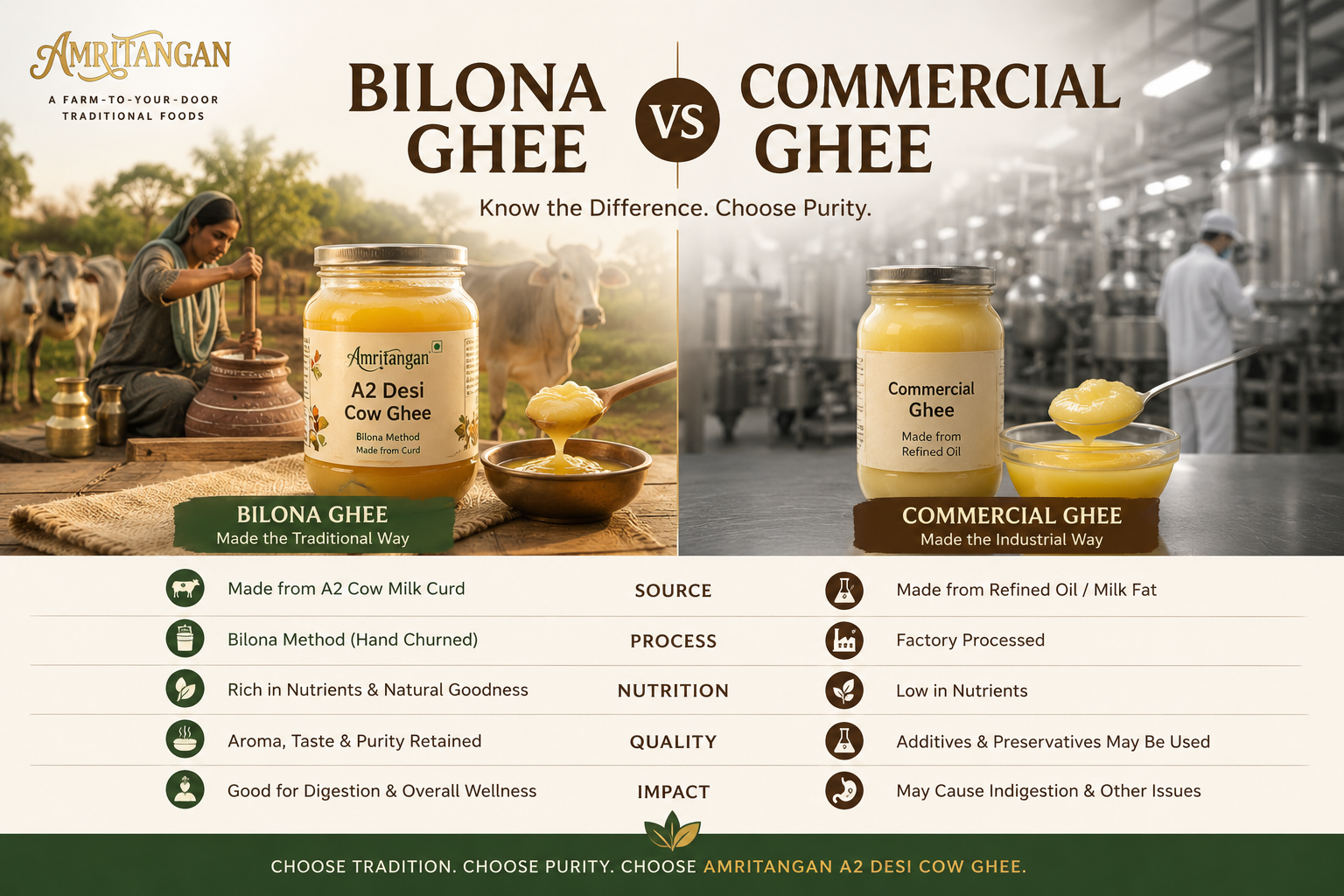
Bilona Ghee vs. Commercial Ghee

ghee

The Golden Truth: Bilona Ghee vs. Commercial Ghee – Why Your Choice Matters

In every Indian household, ghee is more than just an ingredient; it is a symbol of nourishment, a staple of Ayurveda, and a memory of childhood. We all remember the distinct, nutty aroma of ghee being tempered over dal or spread generously on hot rotis. However, as our lives moved from villages to metropolitan cities, the "traditional hand-churned ghee" was replaced by "mass-produced factory jars."

Today, the market is flooded with brands claiming to be "pure" and "desi." But is all ghee created equal? If you look closely at the science and the process, you will find a massive divide between Commercial Ghee and Traditional Bilona Ghee.

In this comprehensive guide, we will explore why the method of preparation changes everything—from the molecular structure of the fat to the way your body digests it.

1. The Anatomy of Commercial Ghee: Convenience Over Quality

Most of the ghee found on supermarket shelves today is produced using the Direct Cream Method. This is an industrial-scale process designed for speed, high volume, and low cost.

How it is Made:

In a factory setting, thousands of liters of milk are put into high-speed separators. These machines pull the cream (malai) away from the milk almost instantly. This raw cream is then heated at extremely high temperatures in large metal boilers until the water evaporates and the fat separates.

The Downside of Industrial Production:

  • The Missing Fermentation: The most critical flaw in commercial ghee is that it skips the fermentation process. In the traditional way, milk must become curd before becoming ghee. Commercial ghee is essentially "boiled butterfat."

  • High-Heat Denaturation: To speed up production, factories use very high heat. This often destroys the delicate fat-soluble vitamins (A, D, E, and K) and alters the natural antioxidants present in the milk.

  • Neutralizers and Additives: Because mass-produced milk comes from various sources, it can sometimes be acidic. Factories often use chemicals (neutralizers) to balance the pH. Additionally, artificial flavors or colors are sometimes added to give it a "consistent" look and smell across millions of jars.

  • The Source of Milk: Commercial ghee usually comes from "HF" (Holstein-Friesian) cows or mixed breeds, which produce A1 protein milk. A1 protein has been linked in various studies to digestive discomfort and inflammation.


2. The Sacred Art of Bilona Ghee: A Slow Revolution

The word "Bilona" refers to the wooden whisk used to churn curd. This method is rooted in the 3,000-year-old tradition of Ayurveda. It is not just a process; it is a biological transformation of milk into a "superfood."

The 5-Step Vedic Process:

To understand why Bilona ghee is superior, we must look at the labor-intensive steps involved:

  1. Boiling: High-quality A2 milk (from indigenous cows like Gir or Sahiwal) is boiled slowly over a fire. This kills harmful bacteria while keeping the nutrients intact.

  2. Curdling: The milk is cooled and a "culture" (starter) is added to turn it into curd (dahi) overnight. This fermentation breaks down the lactose, making it easier for even lactose-intolerant people to consume.

  3. Churning (The Bilona Step): The curd is churned using a wooden whisk. In the traditional "Manthan" process, the whisk moves in a bi-directional motion (clockwise and anti-clockwise). This gentle friction separates the butter (makkhan) from the buttermilk.

  4. Washing: The butter is separated and washed to remove any remaining traces of buttermilk.

  5. Slow Cooking: The butter is placed in a vessel and cooked on a low flame. As the water evaporates, the milk solids settle at the bottom, leaving behind a golden, transparent liquid with a heavenly aroma.

3. Comparison: Why Bilona Ghee is Worth the Premium

FeatureCommercial GheeBilona Desi Ghee
Primary IngredientMilk Cream (Malai)Cultured Curd (Dahi)
Preparation TimeA few hours24 to 36 hours
DigestionCan feel heavy or cause acidityExtremely light and gut-friendly
Nutritional ProfileBasic fats, low vitaminsHigh in CLA, Butyric Acid, and Omeags
TextureGreasy or waxyNaturally Granular (Danedaar)
AromaMild or artificialDeep, nutty, and traditional

4. The Health Science: Why Your Gut Prefers Bilona

The biggest advantage of Bilona ghee is its chemical composition. Because it is made from curd, it contains higher levels of Butyric Acid.

The Power of Butyric Acid:

Our colon cells use butyric acid as their preferred source of energy. Bilona ghee helps in:

  • Healing the Gut Lining: It helps repair the intestinal wall, making it a great choice for people with IBS or leaky gut.

  • Anti-Inflammatory Properties: It reduces inflammation in the digestive tract.

  • Boosting Immunity: A healthy gut is the foundation of 70% of our immune system.

Rich in CLA (Conjugated Linoleic Acid):

Contrary to the myth that ghee makes you fat, the CLA found in A2 Bilona ghee actually helps in weight management. CLA is known to improve metabolism and help the body burn stubborn fat while maintaining lean muscle mass.


5. Decoding the "Danedaar" Texture

Have you ever wondered why some ghee looks like smooth lard while others have beautiful, tiny grains? In India, we call this "Danedaar" texture.

The granulation of ghee is a sign of its purity and the slow-cooking process. When ghee is cooled slowly, the fat molecules crystallize into grains. Commercial ghee, which is often processed with rapid cooling or stabilizers, loses this natural structure. Authentic Bilona ghee will always have a distinct graininess that melts the moment it touches a hot paratha.

6. Buffalo Ghee vs. Cow Ghee: A Quick Side Note

While Bilona cow ghee is the gold standard in Ayurveda, Bilona Buffalo Ghee has its own unique place.

  • Appearance: Buffalo ghee is typically off-white, whereas cow ghee is golden-yellow.

  • Benefits: Buffalo ghee is richer in phosphorus and magnesium. It is excellent for those looking to gain healthy weight, such as growing children or athletes.

  • The Rule Stays the Same: Regardless of the animal, the Bilona method is what makes the ghee medicinal.

7. How to Identify Pure Ghee at Home

In an age of adulteration, you don't need a lab to check your ghee. Here are three simple tests:

  1. The Palm Test: Place a teaspoon of ghee on your palm. Pure Bilona ghee has a melting point slightly below body temperature. It should start melting instantly just from your body heat.

  2. The Heating Test: Heat a spoonful of ghee in a pan. If it melts immediately and turns dark brownish-maroon, it is pure. If it takes time to melt and turns light yellow, it may be adulterated with vegetable oils.

  3. The Iodine Test: Add a drop of iodine to a small amount of melted ghee. If the ghee turns blue, it means it contains starch (like mashed potatoes or cornflour).

8. Sustainability and Ethics: The Story Behind the Jar

When you buy a jar of Bilona ghee, you aren't just buying food; you are supporting a sustainable ecosystem.

  • Ethical Milking: Traditional farms usually follow the "Ahinsa" (non-violent) milking method, where the calf is fed first before the milk is collected.

  • Empowering Farmers: Bilona ghee requires manual labor, providing employment to rural artisans and maintaining the heritage of Indian cattle breeds.

  • Zero Waste: The leftover buttermilk from the churning process is often used by villagers as a probiotic drink or to make other traditional foods.

9. Conclusion: Choose Purity for Your Family

The difference between Commercial and Bilona ghee is the difference between "mass production" and "mindful creation." While commercial ghee is cheaper and more accessible, it lacks the life-giving properties (Prana) that Ayurveda describes.

By choosing Bilona Ghee, you are opting for a lactose-free, nutrient-dense superfood that supports your digestion, enhances your skin glow, and provides sustained energy. It is time to move away from the industrial jars and bring back the golden elixir that our ancestors trusted.


Ready to experience the real taste of tradition?

At Amritangan, we take pride in our roots. Our ghee is crafted in small batches using the authentic Bilona method, ensuring that every grain (dana) carries the promise of purity.

[Explore our range of A2 Cow and Buffalo Ghee – Shop Now]

Leave a Reply

Your email address will not be published. Required fields are marked *