Rakhi Special Sale Live Use "RAKHI10" Coupon Code
Rakhi Special Sale Live Use "RAKHI10" Coupon Code
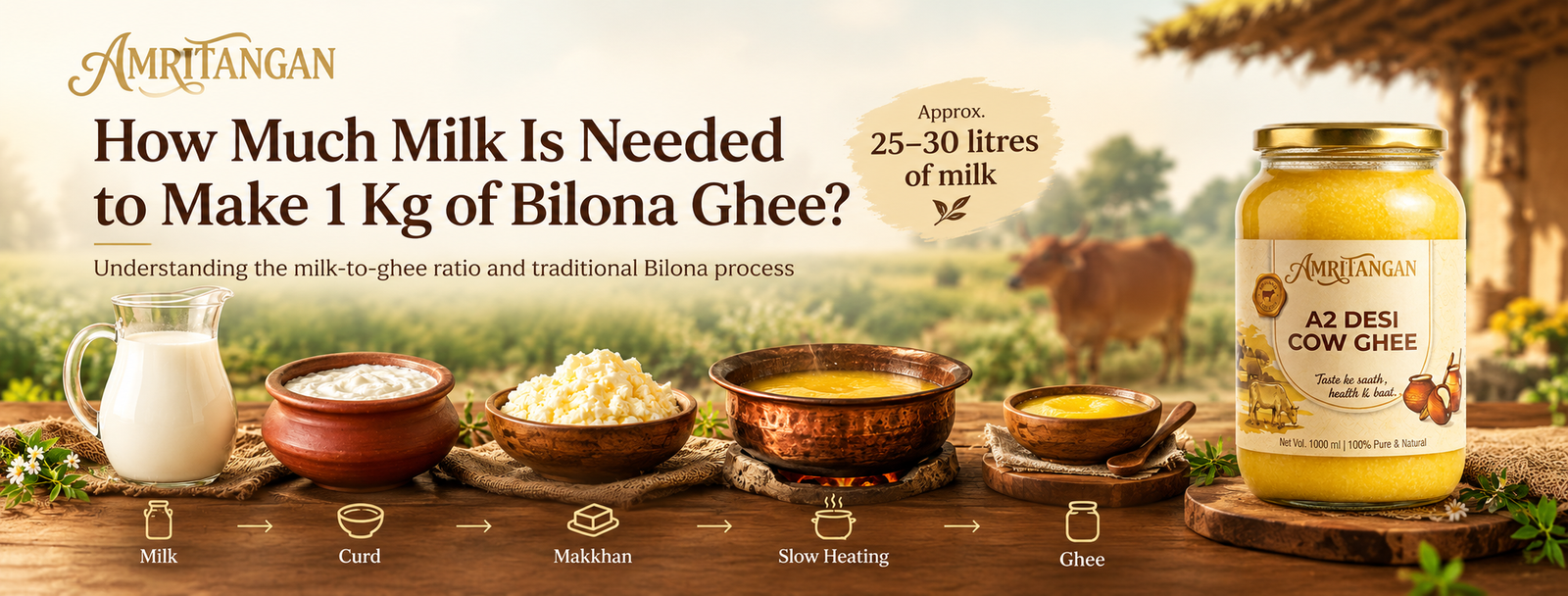
Have you ever wondered how much milk actually goes into making 1 kg of Bilona ghee?
A small jar of ghee may look simple, but traditional Bilona ghee involves several stages before it reaches your kitchen. Fresh milk is first converted into curd, the curd is traditionally churned to separate makkhan (butter), and the butter is then slowly heated to make ghee.
So, how much milk does it take?
As a practical estimate, around 25–30 litres of cow milk may be required to make approximately 1 kg of traditional Bilona ghee. However, this is not a fixed number. The actual quantity can vary depending on the fat content of the milk, cow breed, season, milk composition and efficiency of the production process.
In this article, we will explain the milk-to-ghee ratio, how Bilona ghee is made, why the quantity can vary and why traditional Bilona ghee involves considerably more time and effort than the final jar suggests.
A commonly cited practical range is approximately 25–30 litres of cow milk for 1 kg of traditional Bilona ghee.
But there is no universal fixed ratio.
The amount of milk required can change because milk is a natural product. Its fat content and composition can vary depending on the breed, feed, season, stage of lactation and other factors.
| Quantity | Approximate Requirement |
|---|---|
| 1 kg Bilona ghee | Around 25–30 litres of cow milk* |
*The actual yield can vary from batch to batch.
The important thing to understand is that ghee is a concentrated milk-fat product. During processing, much of the water and non-fat components of milk are separated, leaving behind a much smaller quantity of ghee.
Milk contains much more than fat.
It contains water, milk proteins, lactose, minerals and milk fat. Ghee, on the other hand, is a highly concentrated milk-fat product.
According to the Food Safety and Standards Authority of India (FSSAI), ghee is a milk-fat product produced through processes that result in almost total removal of water and milk solids-not-fat. FSSAI standards specify a minimum milk-fat content of 99.5% and a maximum moisture level of 0.5% for ghee.
This helps explain why a large quantity of milk can eventually result in a much smaller quantity of ghee.
Think of the process like this:
Milk → Curd → Makkhan → Ghee
At every stage, different components are separated until the concentrated fat remains.
The traditional Bilona process involves multiple stages. Unlike a simple cream-to-ghee process, Bilona ghee traditionally starts with milk that is first converted into curd.
Let’s look at the process step by step.
The process begins with fresh cow milk.
The quality and composition of the milk are important because the amount of fat naturally present in the milk affects the eventual ghee yield.
Milk from different cows does not always have exactly the same composition. This is one of the reasons why the final amount of ghee can vary from batch to batch.
The milk is first prepared and cultured to form curd.
This is an important part of the traditional Bilona process.
Instead of directly separating cream and turning it into ghee, the traditional method takes the milk through the curd stage first.
Once the curd is ready, it is churned to separate the butter, commonly called makkhan, from the buttermilk.
This churning stage is where the word “Bilona” is closely associated with the traditional process.
The butter is then collected for the next stage.
The collected butter is gently heated.
As it cooks, moisture evaporates and the milk solids separate from the fat. The remaining clarified milk fat becomes ghee.
This is why the process takes considerably more time than simply melting butter.
Once the ghee reaches the desired stage, the remaining solids are separated and the finished ghee is collected.
The result is a concentrated, aromatic ghee with the characteristic flavour and texture associated with traditionally prepared ghee.
If you want to understand this traditional process in more detail, read our guide on What Is the Bilona Method? Why It Makes A2 Ghee Different.
This is one of the most important things to understand.
The 25–30 litre figure is an approximate range, not a guaranteed formula.
Milk is a natural food, so its composition can change.
Several factors can influence the final amount of ghee.
The amount of fat present in milk is one of the biggest factors affecting ghee yield.
Milk with a higher fat content has more milk fat available to be converted into ghee.
Therefore, two batches containing the same amount of milk may not necessarily produce exactly the same amount of ghee.
Milk composition varies between different cow breeds.
The natural fat content and other characteristics of milk can influence the amount of butter and ultimately ghee obtained from a given quantity of milk.
Milk composition can also vary with seasonal conditions.
Changes in feed, weather and other farming factors can influence milk characteristics and therefore affect the eventual yield.
What a cow eats can influence the composition of its milk.
This is another reason why it is difficult to give one exact milk-to-ghee ratio that applies to every batch.
The efficiency of the churning process also matters.
The amount of butter successfully separated and collected from the curd can affect the final ghee yield.
The final stage also requires careful heating.
The goal is to remove moisture and separate the milk solids while retaining the desired quality of the ghee.
Because all these factors can vary, the final yield can vary as well.
This question needs a little context.
Different types of ghee can be produced using different manufacturing processes.
Traditional Bilona production follows the general route:
Milk → Curd → Butter → Ghee
Other commercial processes may begin with separated cream or other milk-fat streams before producing ghee.
Therefore, it is better not to judge ghee simply by asking which method “uses more milk.” The actual milk requirement depends on the fat content of the starting material and the efficiency of the production process.
What makes the traditional Bilona method distinctive is the curd-churning route and the additional processing involved, rather than simply the number of litres of milk used.
Once you understand the production process, the price difference becomes easier to understand.
A jar of traditional Bilona ghee represents much more than the finished product sitting on the shelf.
The production involves:
This takes time, milk, labour and careful handling.
That is why traditionally prepared Bilona ghee can cost more than products manufactured through faster, more industrial processes.
For a deeper explanation of the economics and production effort behind Bilona ghee, read our article Is A2 Bilona Ghee Worth the Price? Here’s What You’re Really Paying For.
Let’s simplify the entire process.
Imagine starting with approximately 25–30 litres of suitable cow milk.
The milk first goes through the curd-setting stage.
25–30 litres milk
↓
Curd
↓
Traditional churning
↓
Makkhan / Butter
↓
Slow heating
↓
Ghee
↓
Approximately 1 kg ghee*
The important word here is approximately.
The actual output depends on the natural fat content of the milk and the efficiency of the production process.
So, if someone tells you that exactly 25 litres of milk will always produce exactly 1 kg of ghee, that should not be treated as a universal rule.
Understanding the milk-to-ghee ratio can help consumers look beyond the price printed on a jar.
When comparing two ghee products, don’t look only at:
“Which jar is cheaper?”
Instead, consider:
Price is only one part of the picture.
The production method, raw material, processing time and brand transparency also matter.
At Amritangan, our A2 Desi Cow Ghee follows the traditional Bilona approach.
The process focuses on taking the milk through the traditional stages of milk → curd → makkhan → ghee, rather than treating ghee as simply another mass-produced cooking fat.
This traditional approach requires more time and careful handling, but it also preserves the connection between the raw milk and the finished ghee.
For families who value traditional food preparation, understanding how a product is made can be just as important as knowing what is written on the front of the jar.
You can explore Amritangan A2 Desi Cow Ghee to learn more about the product and its traditional preparation.
When you look at a 1 kg jar of ghee, it is easy to focus only on the quantity inside.
But traditional Bilona ghee represents a longer journey.
Milk → Curd → Makkhan → Ghee
A large quantity of milk is gradually transformed into a much smaller quantity of concentrated milk fat.
The exact milk requirement can vary, but a practical estimate for traditional cow-milk Bilona ghee is around 25–30 litres for approximately 1 kg of ghee.
So the next time you see a jar of Bilona ghee, remember that the final quantity represents not only the milk used, but also the time, traditional processing and effort that went into making it.
Read more: Cold-Pressed Mustard Oil vs Refined Mustard Oil: What’s Actually Different?
Approximately 25–30 litres of cow milk is a commonly cited practical range for producing around 1 kg of traditional Bilona ghee. However, the actual quantity can vary depending on milk fat content, breed, season and processing efficiency.
No. There is no fixed universal ratio. The yield depends largely on the amount of milk fat available and how efficiently the butter is recovered and processed.
Milk contains a large amount of water and other non-fat components. Ghee is a concentrated milk-fat product, so only a portion of the original milk becomes the final ghee.
The traditional Bilona method generally involves converting milk into curd, churning the curd to obtain butter or makkhan, and then slowly heating the butter to make ghee.
Traditional Bilona ghee can cost more because it involves more stages, time, milk, labour and careful handling compared with faster production methods.
No. A litre measures volume, while a kilogram measures weight. They should not automatically be considered the same quantity.
Yes. The fat content and composition of milk can affect the amount of butter and ghee that can ultimately be obtained.
So, how much milk is needed to make 1 kg of Bilona ghee?
A practical estimate is around 25–30 litres of cow milk for approximately 1 kg of traditional Bilona ghee, but the exact amount can vary from batch to batch.
The important takeaway is that traditional ghee production is not simply about heating milk and collecting the result. It involves several stages, from milk to curd, curd to butter and butter to ghee.
Understanding this process helps explain why traditional Bilona ghee takes more time, requires more handling and can have a higher price than ordinary commercial ghee.
And when choosing ghee for your family, knowing how it is made can be just as important as knowing how much it costs.
Note: The 25–30 litre figure is an approximate practical range, not a fixed manufacturing standard. Actual yield varies with milk composition and processing conditions.
No account yet?
Create an AccountNeed help? Our team is just a message away












One thought on “How Much Milk Is Needed to Make 1 Kg of Bilona Ghee?”