Rakhi Special Sale Live Use "RAKHI10" Coupon Code
Rakhi Special Sale Live Use "RAKHI10" Coupon Code
Walk into any Indian kitchen and you’ll almost certainly find a bottle of mustard oil sitting on the shelf. It’s been a staple in Indian cooking for generations — used for tadka, pickles, frying, and even traditional skin and hair care. But here’s a question most of us never stop to ask: is the mustard oil we’re using actually good for us, or has it lost its goodness somewhere between the field and the bottle?
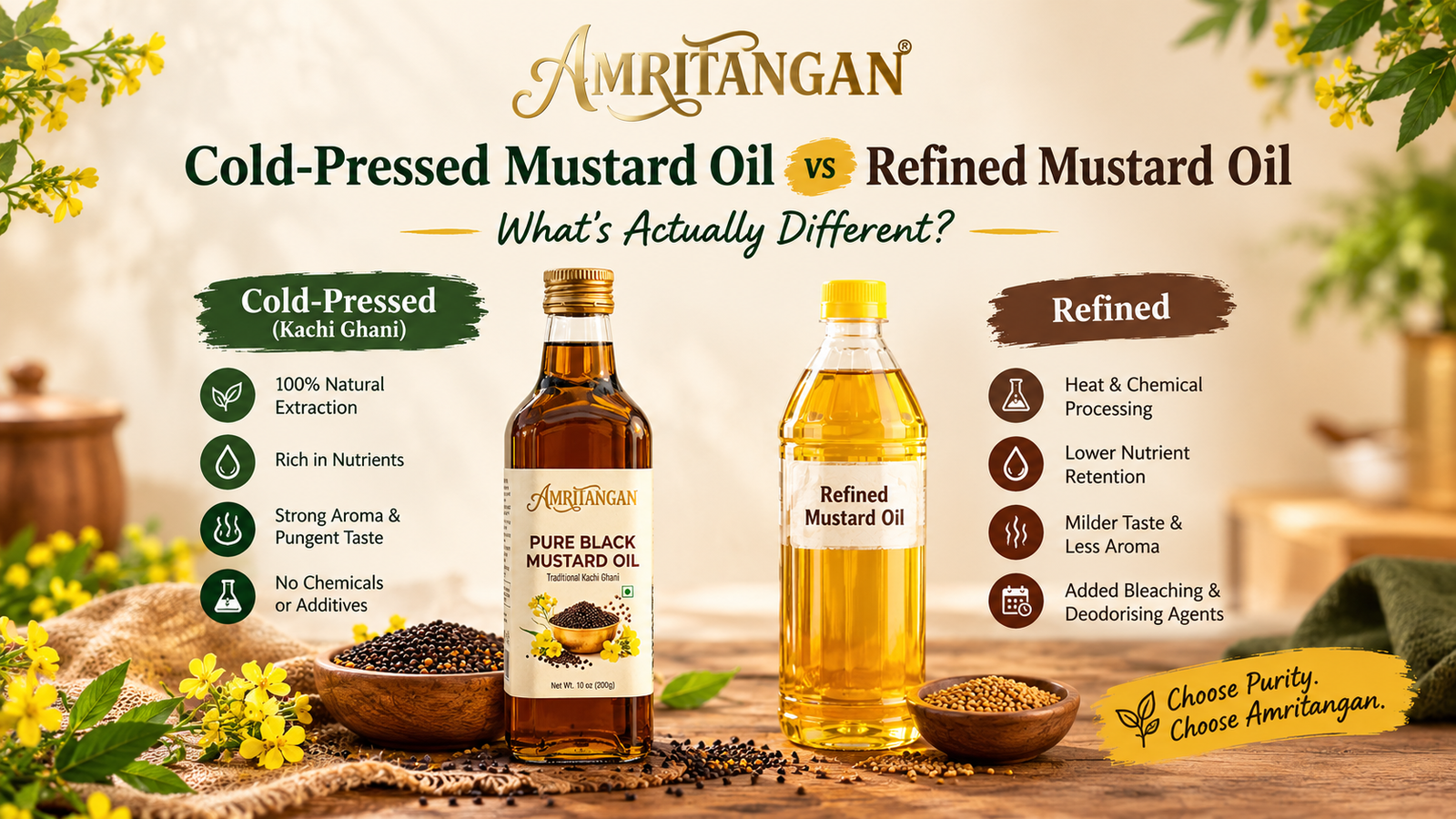
The answer usually comes down to one thing — how the oil was extracted. And that’s where the real difference between cold-pressed (kachi ghani) mustard oil and refined mustard oil begins.
Cold-pressed mustard oil is extracted using the traditional kachi ghani method — mustard seeds are crushed slowly using a wooden or stone press (ghani), without applying external heat. The process relies purely on mechanical pressure, which means the oil retains its natural colour, pungency, and nutrients.
Because there’s no heating or chemical treatment involved, cold-pressed oil keeps:
This is the same method farmers and households across North India have relied on for centuries — and it’s the method Amritangan uses to produce its Desi Mustard Oil.
Refined mustard oil, on the other hand, goes through a very different journey. After the initial extraction (often using heat or chemical solvents like hexane to maximise yield), the oil is:
The result is a lighter, milder-tasting oil — but one that has lost much of its natural nutrient profile in the process. Refined oils are optimised for shelf life and consistency, not necessarily for nutrition or authentic flavour.
| Aspect | Cold-Pressed (Kachi Ghani) | Refined Mustard Oil |
|---|---|---|
| Extraction method | Mechanical pressing, no heat | Heat/chemical solvent extraction |
| Nutrient retention | High — natural antioxidants intact | Lower — nutrients degraded during processing |
| Taste & aroma | Strong, pungent, authentic | Mild, neutral |
| Colour | Deep golden-amber | Lighter yellow |
| Additives | None | May involve bleaching/deodorising agents |
| Smoke point | Slightly lower | Slightly higher |
| Best suited for | Tadka, pickles, traditional cooking, skin/hair use | High-heat, large-scale commercial frying |
Many people assume the sharp smell of cold-pressed mustard oil is a downside — but that pungency comes from a natural compound called allyl isothiocyanate, which is largely responsible for mustard oil’s antimicrobial and digestive properties in traditional use. When oil is refined and deodorised, this compound is significantly reduced, along with much of what made mustard oil special in the first place.
If your mustard oil has little to no smell, it’s a good sign it’s been heavily refined.
For everyday Indian cooking — tadka, sabzi, achaar, and pan-frying — cold-pressed mustard oil is an excellent choice. It has traditionally been used across Bengal, Rajasthan, Punjab, and UP precisely because of its flavour and heat tolerance for typical home cooking.
For very high-temperature deep frying done repeatedly, refined oils are sometimes preferred commercially simply because they’re more heat-stable and flavour-neutral. But for home kitchens focused on health and authentic taste, cold-pressed remains the more traditional and wholesome option.
Read Also: Why Is Ghee Used in Krishna Bhog?
Not all “cold-pressed” labels mean the same thing. Here’s what to check before you buy:
At Amritangan, our Desi Mustard Oil is extracted using the traditional kachi ghani method — cold-pressed, unrefined, and free from any chemical processing. We work directly with farmers to source quality mustard seeds, and every batch is tested for purity before it reaches your kitchen.
If you’ve grown used to the mild taste of refined oils, switching to a genuine cold-pressed variety might take a little getting used to — but that sharp, pungent aroma is exactly what generations of Indian kitchens have relied on for real flavour and nourishment.
Explore Amritangan’s Cold-Pressed Mustard Oil →
Yes, cold-pressed mustard oil has been used safely in Indian households for generations and is well suited for everyday cooking like tadka, sautéing, and pickling.
Traditionally, mustard oil is heated until it reaches its smoke point before cooking, which helps mellow its sharp raw pungency — a common practice before adding it to tadka or curries.
That’s actually a good sign — it means the oil hasn’t been deodorised or chemically treated, and retains its natural compounds.
Yes, this is one of its traditional uses across Indian households, thanks to its natural, unrefined composition.
No account yet?
Create an AccountNeed help? Our team is just a message away