Rakhi Special Sale Live Use "RAKHI10" Coupon Code
Rakhi Special Sale Live Use "RAKHI10" Coupon Code
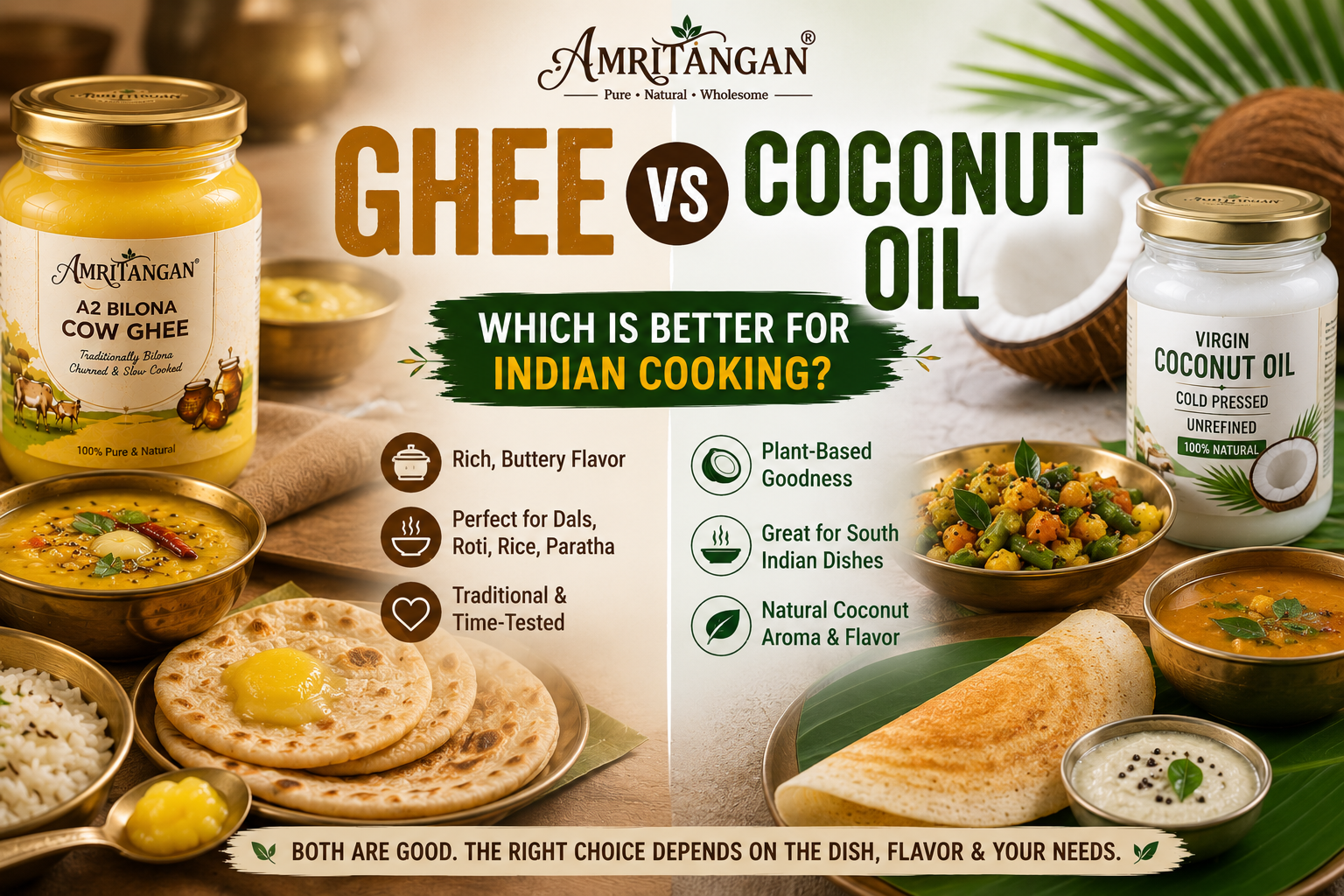
If you’re cooking Indian food regularly, you’ve probably wondered: Should I use ghee or coconut oil?
Both are popular cooking fats, but they are quite different in flavour, texture, origin and the dishes they complement best. Ghee brings a rich, buttery aroma that works beautifully with dal, khichdi, roti and many traditional Indian recipes. Coconut oil, on the other hand, has a characteristic coconut flavour that pairs particularly well with many South Indian dishes and coconut-based recipes.
So, is ghee better than coconut oil?
There isn’t one answer that works for everyone.
The better choice depends on the dish you’re preparing, the flavour you want, how you cook, how much fat you use and your overall diet.
In this guide, we’ll compare ghee vs coconut oil for Indian cooking, including their nutritional profiles, calories, cooking uses, flavour, weight-management considerations and the dishes where each one works best.
Neither ghee nor coconut oil is universally better. Ghee is particularly suited to traditional Indian dishes where a rich, buttery flavour is desired, while coconut oil works especially well in recipes where its characteristic coconut flavour complements the dish. Both are concentrated sources of fat, so portion size matters.
Before getting into the details, here’s a quick comparison.
| Feature | Ghee | Coconut Oil |
| Source | Milk fat | Coconut |
| Type | Dairy-derived | Plant-based |
| Flavour | Rich and buttery | Mild to distinctly coconutty |
| Texture | Solid/semi-solid depending on temperature | Solid/semi-solid depending on temperature |
| Carbohydrates | Very low | Very low |
| Protein | Very low | None |
| Calories | High | High |
| Saturated fat | High | High |
| Traditional Indian use | Very widespread | Especially common in South India |
| Vegan | No | Yes |
| Best known for | Dal, tadka, roti, rice, khichdi | South Indian dishes, coconut-based recipes |
The biggest takeaway is simple:
Both are concentrated sources of fat, so neither should be used without considering quantity.
The choice should also depend on the food you’re cooking.
Ghee is a clarified milk fat that has been an important part of Indian cooking for generations.
Traditional ghee-making can involve converting milk into curd, churning the curd to obtain butter and then slowly heating the butter until the moisture is removed and ghee remains.
The traditional Bilona process follows this milk → curd → butter → ghee sequence. You can learn more about it in our detailed guide on What Is the Bilona Method?.
Ghee is valued in Indian kitchens for its:
A small amount can make a noticeable difference to foods such as dal, khichdi, rice and paratha.
Coconut oil is a plant-based fat extracted from coconut.
It is widely used in cooking across tropical regions and has a particularly strong culinary connection with several South Indian cuisines.
Depending on the type, coconut oil can have a noticeable coconut aroma and flavour.
This makes it especially suitable for dishes where that flavour complements the other ingredients.
For example, coconut oil can work beautifully in:
Refined coconut oil generally has a more neutral flavour, while virgin coconut oil tends to retain more of the characteristic coconut aroma.
Related Reading – Ghee in Coffee: Is This Trend Actually Worth Trying?
One of the biggest mistakes people make when comparing cooking fats is assuming that one is automatically “healthy” and the other is automatically “unhealthy.”
The reality is more nuanced.
Both ghee and coconut oil are concentrated sources of fat and calories.
| Nutritional Feature | Ghee | Coconut Oil |
| Main macronutrient | Fat | Fat |
| Carbohydrates | ~0 | ~0 |
| Protein | Very low | 0 |
| Calories | High | High |
| Saturated fat | High | High |
| Plant-based | No | Yes |
Because both are calorie-dense, the amount you use matters.
A dish cooked with one teaspoon of fat is very different nutritionally from the same dish prepared with several tablespoons.
So when choosing between ghee and coconut oil, don’t look only at the ingredient itself. Consider your overall dietary pattern and the amount you consume.
This is where the comparison becomes much more useful.
Instead of asking, “Which one is healthier?” a better question is:
“Which one works better for the food I’m preparing?”
Let’s look at some common Indian cooking situations.
Ghee is a classic choice for dal.
A small amount added to tadka can bring a rich aroma to ingredients such as:
The buttery character of ghee works particularly well with simple dals.
If you’re making traditional dal and want that familiar rich flavour, ghee is an excellent choice.
Khichdi and ghee are a natural combination in many Indian households.
A small amount of ghee can add richness to a simple bowl of rice and lentils without requiring complicated ingredients.
Ghee is also commonly used as a finishing ingredient for roti and paratha.
A light coating can add:
If you’re looking for a traditional Indian flavour profile, ghee is generally the more natural choice.
A small amount of ghee can work particularly well with:
Its rich aroma can complement spices without introducing a strong coconut flavour.
Coconut oil has a particularly strong place in South Indian cuisine.
Its characteristic aroma can complement dishes containing:
For certain traditional preparations, replacing coconut oil with ghee can completely change the flavour profile.
If the coconut flavour is part of what makes the dish special, coconut oil can be the better culinary choice.
This is another area where coconut oil can make sense.
If you’re preparing a coconut-based curry, the natural coconut aroma can complement the dish instead of competing with it.
Here’s a practical cheat sheet:
| Indian Dish | Better Choice | Why |
| Dal Tadka | Ghee | Rich traditional flavour |
| Khichdi | Ghee | Complements rice and lentils |
| Paratha | Ghee | Rich, buttery finish |
| Roti | Ghee | Traditional flavour |
| Jeera Rice | Ghee | Works well with cumin |
| Dal Rice | Ghee | Adds aroma and richness |
| South Indian Vegetable Stir-Fry | Coconut Oil | Coconut flavour complements vegetables |
| Avial | Coconut Oil | Suits the traditional flavour profile |
| Coconut-Based Curry | Coconut Oil | Enhances coconut notes |
| Everyday Sabzi | Either | Depends on the recipe |
| Traditional Indian Sweets | Ghee | Rich flavour works well |
Of course, these aren’t strict rules.
You can experiment with both and choose what you personally enjoy.
This is completely subjective.
Ghee generally has a:
It’s particularly good when you want the fat itself to add richness to the dish.
Coconut oil can have a:
It’s particularly useful when coconut flavour fits naturally into the recipe.
Neither tastes universally better.
Think about the dish first.
If you’re cooking dal, ghee may be the obvious choice.
If you’re preparing a coconut-based South Indian curry, coconut oil may make more sense.
This is one of the most searched questions around the two.
The honest answer is:
There isn’t a simple yes-or-no answer.
Both are fats, and both contain substantial amounts of saturated fat.
That doesn’t mean you need to completely eliminate either one.
But it does mean that portion size and your overall diet matter.
Instead of thinking:
“Ghee is healthy, so I can use unlimited amounts.”
or:
“Coconut oil is natural, so I don’t need to count it.”
a better approach is:
Use cooking fats in sensible amounts and choose them according to the dish and your dietary needs.
Your overall eating pattern matters much more than whether one meal was cooked with ghee or coconut oil.
Weight loss is another area where both ingredients are frequently surrounded by exaggerated claims.
Let’s make it simple.
Both are calorie-dense.
Adding several spoonfuls of either one can increase the calorie content of your meals considerably.
If you’re trying to manage your weight, focus on:
You don’t necessarily need to eliminate ghee or coconut oil.
Instead, use a measured amount and account for it as part of your total dietary fat intake.
For a more detailed look at ghee portions, read our guide on How Much Ghee Should You Eat Per Day?.
The better choice for weight management is usually the one you use in a sensible quantity—not the one marketed as a “fat-burning” food.
Yes, ghee can be part of everyday cooking for many people.
The important distinction is between daily use and unlimited use.
Using a small amount of ghee for dal or vegetables is very different from adding several spoonfuls to every meal.
Our guide Can You Cook with Ghee Every Day? explains how daily ghee consumption can fit into an overall diet and why portion control matters.
Remember that ghee used for:
all contributes to your total intake.
Yes.
There’s no rule saying that you have to choose only one.
For example, you could use a small amount of coconut oil while preparing a vegetable dish and finish it with a small amount of ghee if the flavours work together.
However, remember that combining them also increases the total amount of added fat.
So if you use both, keep the quantities sensible.
Use each fat for the flavour or cooking purpose it serves best rather than combining them simply because “more is better.”
The answer depends on what you’re cooking.
There’s no need to force yourself into an “either-or” approach.
A well-stocked Indian kitchen can have different cooking fats for different recipes.
This is arguably more important than deciding which one is “better.”
Both ghee and coconut oil are concentrated sources of fat.
That means a little can go a long way in terms of calories.
Instead of pouring directly from the container, measuring your cooking fat occasionally can help you understand how much you’re actually using.
For ghee in particular, remember to count all sources throughout the day.
For example:
all count toward your total intake.
The 2024 ICMR-NIN dietary guidance also emphasizes keeping visible fats such as ghee and butter within appropriate limits based on dietary energy needs.
If you want a practical breakdown, see How Much Ghee Should You Eat Per Day?.
Cooking temperature is another factor to consider.
Different fats have different smoke points, and the exact value can vary depending on the product and processing method.
Rather than choosing a fat solely because someone claims it has a particular smoke point, consider:
A simple rule applies to both:
Avoid unnecessarily overheating cooking fats until they smoke.
For everyday Indian cooking, choosing the fat based on the recipe and using appropriate cooking temperatures is more useful than trying to find one “perfect” fat for every situation.
For many South Indian recipes, coconut oil can be an excellent flavour match.
This is especially true for dishes where coconut, curry leaves, mustard seeds and other traditional ingredients are already part of the flavour profile.
However, that doesn’t mean ghee is unsuitable for South Indian food.
Ghee can also work beautifully in dishes such as:
Again, the recipe matters more than a blanket rule.
For many North Indian dishes, ghee is often the more natural flavour match.
Think about:
The rich aroma of ghee complements these dishes particularly well.
That doesn’t make coconut oil “bad.” It simply means that its flavour may not be the first choice for every traditional North Indian recipe.
Reality: Neither is universally better. Both are concentrated fats and should be consumed according to your dietary needs.
Reality: Coconut oil still contains calories. Using large amounts can increase your total calorie intake.
Reality: More isn’t automatically better. Ghee is concentrated fat, so sensible portions are important.
Reality: Dietary guidance is more nuanced than simply labeling one food as good or bad. Individual needs and the overall diet matter.
Reality: Different dishes have different flavour and cooking requirements.
Dal may taste better with ghee, while a coconut-based curry may work better with coconut oil.
If you’re looking for a traditionally prepared ghee for everyday Indian meals, Amritangan A2 Desi Cow Ghee is made using the traditional Bilona approach.
The process involves milk, curd, butter and slow clarification rather than simply treating ghee as another mass-produced cooking fat.
Its rich aroma makes it particularly suitable for dishes such as:
The important thing, however, is still how much you use.
Choosing a traditionally prepared product doesn’t mean that unlimited quantities are necessary.
Good food is about both quality and balance.
If you’re interested in understanding why traditionally prepared A2 Bilona Ghee can cost more, read Is A2 Bilona Ghee Worth the Price?.
Here’s the simplest way to decide.
Choose ghee.
Choose ghee.
Choose ghee.
Coconut oil can be a great choice.
Coconut oil can work particularly well.
Either can work, depending on the recipe and your preferred flavour.
Focus on quantity and your complete diet, rather than assuming one of these fats can be consumed without limits.
Neither is universally better. Ghee is particularly useful for traditional Indian dishes that benefit from its rich flavour, while coconut oil works well in dishes where coconut flavour complements the recipe.
Coconut oil isn’t automatically healthier than ghee. Both are concentrated fats and contain substantial saturated fat. The appropriate choice depends on your overall diet, portion size and individual nutritional needs.
Yes. Ghee can replace coconut oil in many recipes, but it will change the flavour of the dish. This substitution works particularly well when a richer, buttery taste is desirable.
Yes. Coconut oil can replace ghee in many recipes, but its characteristic coconut flavour may change the final taste.
It depends on the dish. Ghee is particularly suited to dal, khichdi, roti, paratha and many North Indian dishes. Coconut oil is particularly suited to many South Indian and coconut-based preparations.
Both are highly calorie-dense fats, and the exact calories depend on the amount used. Portion size is therefore important with both.
Yes, ghee can be used as part of everyday cooking when consumed in sensible quantities and within an overall balanced diet.
Yes. They can be combined when their flavours work with the recipe. Just remember that using both increases the total amount of added fat.
Neither is a guaranteed weight-loss food. Both contain calories, so the amount consumed and your overall dietary pattern matter more than choosing one over the other.
So, ghee vs coconut oil—which is better for Indian cooking?
The most useful answer isn’t that one ingredient wins every time.
Ghee is an excellent choice for dishes where you want richness, aroma and a traditional buttery flavour. It’s particularly well suited to dal, khichdi, roti, paratha, rice and many Indian sweets.
Coconut oil is an excellent choice when its characteristic flavour complements the recipe, particularly in many South Indian and coconut-based dishes.
And there’s nothing wrong with keeping both in your kitchen.
The real key is using the right fat for the right dish and keeping the quantity sensible.
If you’re choosing ghee, look beyond the front of the jar. Consider the ingredients, preparation method, sourcing and transparency of the brand.
For those who value traditional preparation, Amritangan A2 Bilona Ghee brings the traditional Bilona approach to everyday Indian cooking.
Ultimately:
The best cooking fat isn’t necessarily the one that wins every comparison. It’s the one that suits your recipe, your taste, your dietary needs and the quantity you’re comfortable consuming.
Enjoy your food, use your cooking fats mindfully, and let the dish decide whether it’s a ghee day or a coconut-oil day.
No account yet?
Create an AccountNeed help? Our team is just a message away