Rakhi Special Sale Live Use "RAKHI10" Coupon Code
Rakhi Special Sale Live Use "RAKHI10" Coupon Code
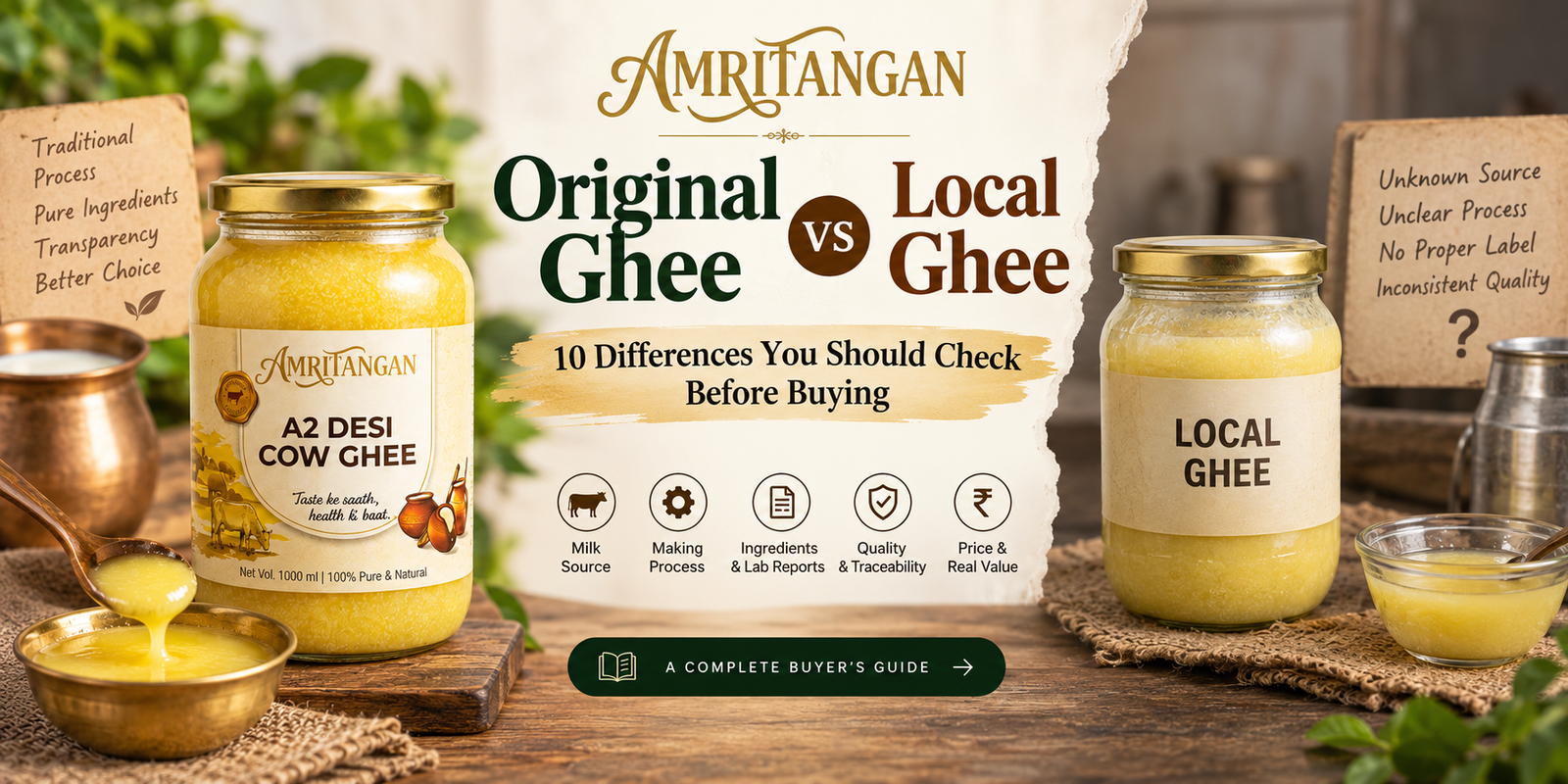
Ghee is a common part of Indian kitchens, but buying the right ghee is not always as simple as picking the most expensive jar or the one with the most attractive label.
You may find ghee from established brands, local dairies, small producers and even household sellers. Some products may look almost identical, while their milk source, preparation method, packaging and quality information can be very different.
This is where the difference between original or authentic ghee and local ghee becomes important.
However, there is one thing worth clarifying from the beginning: local ghee does not automatically mean adulterated or low quality. A local dairy or household producer can make excellent ghee. The more important question is whether the product has a clear source, ingredients, preparation process and reliable quality information.
So, instead of judging ghee only by its price, colour or seller, let’s look at 10 practical things you should check before buying.
Original or authentic ghee is generally ghee made from milk fat without undisclosed oils or fats being added.
A trustworthy product should provide clear information about its ingredients, source and manufacturing process. The label should help you understand what you are actually buying.
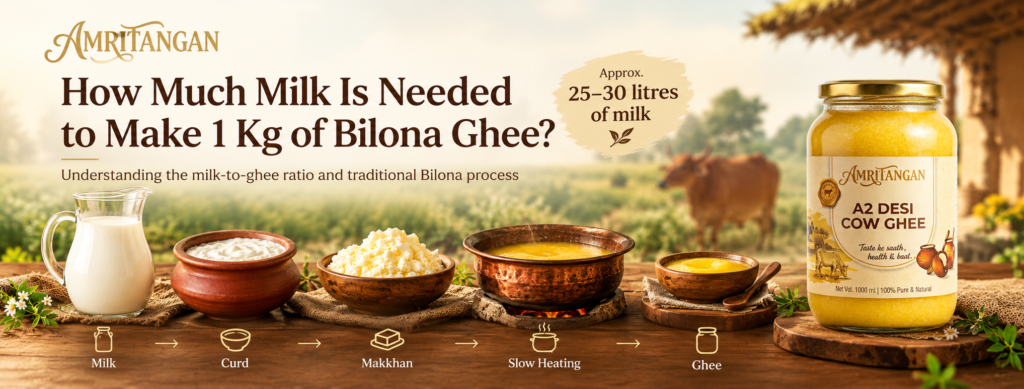
Traditional ghee can be prepared using different methods. One well-known traditional process is the Bilona method, where milk is converted into curd, the curd is traditionally churned to obtain butter, and the butter is then heated to make ghee.
However, the word “traditional” or “authentic” on a label should not be the only reason you trust a product. Actual sourcing, ingredients, manufacturing information and transparency matter more than marketing claims.
For readers interested in the traditional process, you can learn more in our guide: What Is the Bilona Method?
The term local ghee can mean different things depending on who is selling it.
It may refer to:
Being local is not a quality problem by itself.
In fact, some local producers may use good-quality milk and traditional preparation methods. The challenge is that smaller sellers may not always provide the same level of information about sourcing, batches, testing, packaging or traceability.
Therefore, the better approach is not “branded vs local.” Instead, compare the actual product and the information available about it.
Here are 10 important factors to check before buying ghee.
Start by checking where the milk comes from.
Look for information about:
Milk type can influence the taste, aroma, colour and texture of ghee.
A product with clear sourcing information gives you a better idea of what you are buying.
The method used to make ghee can make a difference to the production process.
Ghee can be produced through different processing methods. Traditional Bilona ghee, for example, follows a process involving milk, curd, churning, butter and finally ghee.
The Bilona process can be broadly explained as:
Milk → Curd → Churning → Butter → Ghee
Other producers may use different methods.
The important point is to check whether the manufacturer clearly explains how the ghee is produced instead of relying only on terms such as “pure,” “traditional” or “premium.”
Always check the ingredient list.
A trustworthy ghee label should clearly communicate what the product contains.
Don’t judge a product only by the front of the jar. Marketing claims can tell you about the positioning of a product, but the ingredient declaration provides more useful information about its contents.
If you are comparing two ghee products, take a moment to read both labels carefully.
Authentic ghee usually has a characteristic aroma and flavour.
However, the exact aroma can vary depending on factors such as:
This means there is no single smell that every genuine ghee must have.
More importantly, smell alone cannot prove whether ghee is pure.
A strong or mild aroma should not be treated as a definitive purity test.
Ghee can have different textures.
Depending on temperature, milk source and processing, it may be:
Many people associate a grainy texture with traditionally prepared ghee, but texture by itself is not a guaranteed purity test.
For this reason, don’t reject a ghee simply because it looks different from another jar.
Ghee colour can naturally vary.
Factors such as milk source, animal feed, season and processing can influence its appearance.
Cow ghee may appear yellow or golden, while other ghee can have a different shade.
Therefore:
Yellow colour does not automatically prove purity.
Similarly, a lighter colour does not automatically mean that ghee is fake or adulterated.
Colour is one observation, not a laboratory test.
Consistency is another useful factor when comparing ghee.
Established producers generally have defined manufacturing and packaging processes that can help maintain consistency between batches.
Small or local producers may have more natural variation from one batch to another.
But variation does not automatically mean poor quality or adulteration.
The better question is whether the producer has a consistent process and provides enough information to help customers understand the product.
Good packaging does more than make a product look premium.
Before buying, check whether the container or label provides important information such as:
Clear packaging information makes it easier for consumers to identify the product and store it correctly.
If important information is missing, you may want to consider another product with better transparency.
When it comes to food quality, proper testing and documentation are more meaningful than viral home experiments.
Where available, look for appropriate quality or testing information from the producer.
You may have seen online “purity tests” involving iodine, freezing, colour changes or heating. These can be interesting experiments, but they should not be treated as definitive proof of ghee purity.
Laboratory testing using appropriate methods provides stronger evidence than judging a product through one simple home test.
Price can be useful information, but it should never be the only measure of quality.
Traditionally prepared ghee may cost more because production can involve:
At the same time, a low-priced ghee is not automatically fake, and an expensive ghee is not automatically pure.
The better question is:
What are you actually getting for the price you are paying?
Compare the milk source, ingredients, preparation method, packaging, quantity and available quality information before making a decision.
| Factor | Authentic/Original Ghee | Local Ghee |
| Source information | Usually clearly stated | May vary |
| Production process | Usually documented | May vary |
| Ingredients | Declared on label | Depends on seller |
| Batch consistency | More standardized | Can vary |
| Packaging details | Usually detailed | May be limited |
| Traceability | Usually easier | May be limited |
| Testing information | May be available | May not be available |
| Price | Depends on method & sourcing | Varies widely |
This comparison should not be understood as saying that branded ghee is always better than local ghee. A local producer can also offer high-quality ghee when the sourcing, process and quality standards are clear.
Yes, absolutely.
The word “local” and the word “adulterated” do not mean the same thing.
A small dairy, household producer or local ghee maker can produce excellent ghee.
The challenge for buyers is usually information and traceability.
When purchasing from a local producer, try to understand:
If the answers are clear and the seller is transparent, being a local producer should not automatically be considered a negative.
Instead of relying on one viral purity test or one visual characteristic, use a simple checklist.
Yes, the traditional Bilona process is different from many other ways of producing ghee.
In the traditional Bilona method, milk is first converted into curd. The curd is then churned to separate butter. That butter is subsequently heated to produce ghee.
The basic process is:
Milk → Curd → Churning → Makkhan (Butter) → Ghee
This traditional process involves additional steps compared with simply processing milk fat into ghee.
However, “Bilona” should also be understood as a method of preparation, not by itself a guarantee that every product carrying the word is automatically superior.
If you want to understand the process in detail, read our complete guide: What Is the Bilona Method?
You can also learn more about the reasons families choose traditionally prepared ghee in our previous article: Why Choose A2 Bilona Ghee? 15 Reasons Families Trust Amritangan for Pure Desi Cow Ghee
Traditional Bilona ghee can involve more steps and resources than some other production methods.
The process may require:
Because of these additional steps, traditionally prepared ghee can have a higher production cost.
However, price should always be considered alongside the actual production process.
A higher price alone does not prove better quality, just as a lower price does not automatically mean poor quality.
Many home tests for ghee purity are shared online. Some of the most common include:
Some people freeze ghee and observe how it looks afterward.
However, texture and separation after cooling can be affected by several factors. This test alone cannot establish purity.
A common assumption is that a particular colour means pure ghee.
But natural ghee colour can vary because of milk source, feed, season and processing.
Therefore, colour alone is not a reliable purity test.
Ghee naturally has an aroma, but aroma can vary.
A smell test cannot definitively confirm whether a product is pure.
People sometimes heat ghee and observe how it behaves.
Again, the result can depend on several factors and should not be treated as conclusive evidence.
The iodine test is frequently discussed online as a way to identify certain starch-based adulteration.
However, it should not be treated as a universal or definitive test for ghee purity.
For meaningful quality verification, appropriate laboratory testing and reliable product documentation are more useful than depending on one viral home test.
Home observations can be interesting, but they should not replace proper testing.
The answer is simpler than it may seem.
Instead, look for a product where the:
Local ghee can be excellent, and branded ghee can also vary. What matters most is the evidence and transparency behind the product.
At Amritangan, our focus is on A2 Desi Cow Ghee prepared using the traditional Bilona method.
The traditional process involves converting milk into curd, churning the curd to obtain butter and then preparing ghee from that butter.
Our approach is built around the idea of bringing traditionally prepared ghee from farm to home, while keeping the product and its preparation clear for customers.
If you are comparing different ghee products, we encourage you to look beyond marketing claims and evaluate the source, ingredients, preparation method and available quality information.
That is a better way to choose ghee with confidence.
Read More: How Much Milk Is Needed to Make 1 Kg of Bilona Ghee?
No. Local ghee is not automatically adulterated. A local dairy or household producer can make high-quality ghee. Buyers should focus on sourcing, ingredients, preparation, hygiene, packaging and available quality information.
Start by checking the ingredient list, milk source, manufacturing process, manufacturer details, batch information, dates, packaging and quality documentation. No single colour, smell or home test can conclusively prove purity.
No. Ghee colour can naturally vary depending on factors such as milk source, feed, season and processing. Yellow colour alone does not prove purity.
Not necessarily. Ghee can naturally have different textures depending on temperature, milk source and processing. Graininess alone is not a guaranteed indicator of purity.
Bilona describes a traditional method of preparing ghee involving curd, churning, butter and ghee. Whether a particular product is right for you should be judged by its actual ingredients, sourcing, process and quality information rather than the word “Bilona” alone.
Traditional Bilona production can involve additional milk, curd preparation, churning, butter recovery, slow cooking, labour and quality control. These factors can increase production costs.
No. Freezing, colour, smell, heating and iodine tests should not be considered definitive proof of purity. Appropriate laboratory testing and reliable product documentation provide stronger evidence.
The real difference between one ghee and another is not simply whether it is called “original,” “local,” “premium” or “traditional.”
Look at what is behind the label.
Check the milk source, ingredients, preparation method, manufacturer information, batch details, packaging and quality information before buying.
And remember: local does not automatically mean bad, while expensive does not automatically mean pure.
A transparent product with clear information gives you a much better basis for making an informed choice.
No account yet?
Create an AccountNeed help? Our team is just a message away






One thought on “Original Ghee vs Local Ghee: 10 Differences You Should Check Before Buying”