Rakhi Special Sale Live Use "RAKHI10" Coupon Code
Rakhi Special Sale Live Use "RAKHI10" Coupon Code
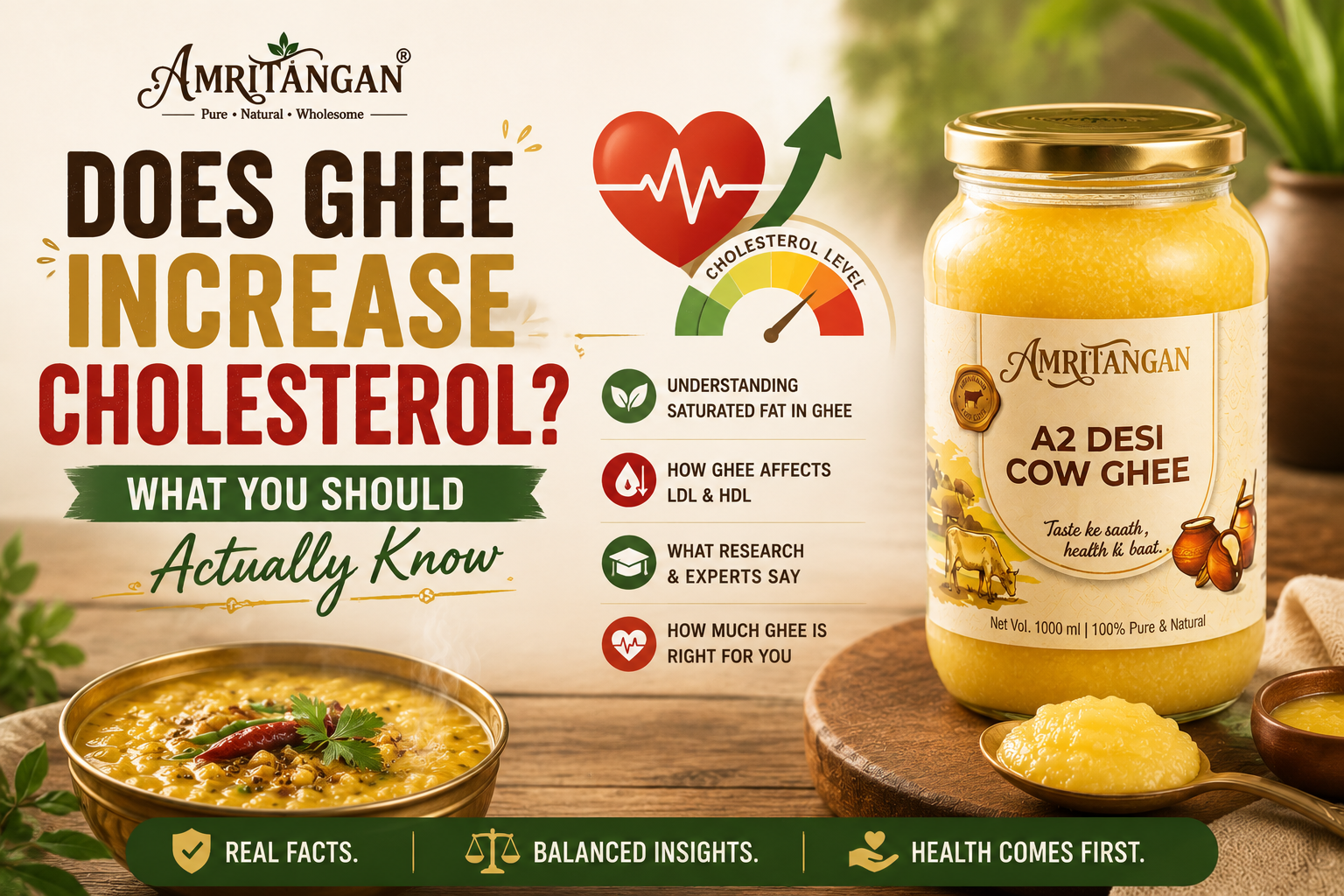
Ghee has been a part of Indian cooking for generations. From dal tadka and roti to khichdi and traditional sweets, its rich flavour makes even simple food taste special.
But there is one question many people have today:
Does ghee increase cholesterol?
The answer is not simply “yes” or “no.”
Ghee is a concentrated source of fat and contains saturated fat. Eating large amounts of saturated fat can raise LDL (“bad”) cholesterol, while the overall quality of your diet and the type of fat replacing it also matter. Current heart-health guidance emphasizes choosing unsaturated fats in place of saturated fats as part of a heart-healthy eating pattern.
At the same time, this does not mean that everyone has to completely eliminate ghee from their diet.
The more useful question is:
How much ghee are you eating, what foods make up the rest of your diet, and what is your individual cholesterol and heart-health risk?
Let’s look at what you should actually know about ghee and cholesterol.
Ghee can contribute to higher LDL cholesterol when consumed in large amounts because it contains saturated fat. However, the effect depends on the amount consumed and the overall diet. Ghee can be used in moderation, but it should not be treated as a food that can be eaten without limits.
Yes, ghee can affect cholesterol levels, particularly because it is rich in saturated fat.
But there is an important distinction.
Eating a small amount of ghee as part of an otherwise balanced diet is very different from consuming several tablespoons of ghee every day while also eating large amounts of butter, cream, cheese and other sources of saturated fat.
The 2024 Dietary Guidelines for Indians from ICMR-NIN classify ghee and butter as “visible fats” and recommend keeping visible-fat intake within appropriate limits. The guidelines specifically state that ghee or butter should be limited to about 1–2 teaspoons per day or avoided if possible, within the context of their dietary guidance.
So, the sensible takeaway isn’t:
“Ghee is bad.”
Nor is it:
“Ghee has no effect on cholesterol.”
Instead:
Ghee is a concentrated fat, so portion size matters.
LDL cholesterol is often called “bad cholesterol.” Higher LDL-C is an important cardiovascular risk factor.
One reason ghee gets attention in cholesterol discussions is its saturated-fat content.
When saturated fats make up a significant portion of the diet, they can increase LDL cholesterol. This is why major heart-health recommendations generally encourage replacing foods high in saturated fat with sources of unsaturated fat.
This doesn’t mean that eating one teaspoon of ghee automatically causes a cholesterol problem.
Your overall diet matters.
For example, consider two different diets:
The amount and overall pattern of fat intake are very different in these two situations.
HDL is commonly called “good cholesterol.”
Some studies involving dairy fats can show changes in HDL, but this doesn’t mean that a food automatically becomes heart-healthy simply because it raises HDL.
Cholesterol is more complicated than one number.
When evaluating cardiovascular risk, healthcare professionals may consider LDL cholesterol, non-HDL cholesterol, triglycerides and other factors rather than focusing on HDL alone.
That’s why the statement:
“Ghee increases HDL, so it must be good for the heart.”
is too simplistic.
Research on ghee is more nuanced than many social-media claims suggest.
One randomized crossover trial involving healthy adults compared diets containing ghee and olive oil. The study found that the ghee diet increased apoB and non-HDL cholesterol compared with the olive-oil diet. The difference in LDL cholesterol between the diets was not statistically significant in that particular study.
This is useful because it shows why comparing fats isn’t simply about asking:
“Which one has less cholesterol?”
Instead, researchers also consider how different fats affect the broader lipid profile.
The same study concluded that its findings supported replacing dietary fats high in saturated fat with fats higher in unsaturated fat to reduce cardiovascular risk.
More broadly, current American Heart Association guidance emphasizes a dietary pattern rich in vegetables, fruits, whole grains, healthy protein sources and unsaturated fats, while limiting saturated fat.
So the evidence does not support saying that ghee has zero effect on cholesterol.
But it also doesn’t mean that a person who enjoys ghee must automatically remove it completely.
This is an important question for people who specifically choose A2 Desi Cow Ghee.
The term A2 refers to a type of beta-casein protein associated with milk. It should not automatically be interpreted as meaning that the resulting ghee has cholesterol-lowering properties.
Similarly, Bilona describes a traditional preparation approach. It doesn’t mean that Bilona ghee can be consumed without considering its fat content.
So claims such as:
❌ “A2 ghee lowers cholesterol.”
❌ “Bilona ghee prevents heart disease.”
❌ “A2 ghee has no effect on LDL.”
should not be made without appropriate clinical evidence.
A more accurate approach is to appreciate A2 Bilona Ghee for its traditional preparation, flavour and culinary qualities, while still consuming it sensibly.
If you want to understand the traditional process behind Bilona ghee, read our guide to What Is the Bilona Method?.
Not necessarily—but that doesn’t mean unlimited ghee is heart healthy.
Heart health depends on many factors, including:
The American Heart Association’s 2026 dietary guidance recommends a heart-healthy eating pattern that emphasizes vegetables and fruits, whole grains, healthy protein sources and unsaturated fats instead of saturated fats.
So rather than asking whether one food is completely “good” or “bad,” it’s more useful to look at the whole dietary pattern.
If you already have high cholesterol, you should be more careful about how much ghee you consume.
This does not mean you should make a major dietary change based only on an online article.
Your doctor or qualified dietitian can help you decide how ghee fits into your diet based on your individual cholesterol levels and cardiovascular risk.
In general, if you’re trying to manage LDL cholesterol:
The 2026 AHA dyslipidemia guideline also emphasizes individualized assessment and management of lipid disorders rather than using a one-size-fits-all approach.
There isn’t one universal amount that is perfect for every person.
Your overall calorie intake, activity level, age, health status and the other fats in your diet all matter.
ICMR-NIN’s 2024 Dietary Guidelines explain that visible fats include cooking oils, ghee and butter and should be limited according to energy needs and physiological status. For a 2,000-kcal diet, the guideline notes that around 27–30 g of visible fat may be appropriate, while specifically advising that ghee or butter be limited to about 1–2 teaspoons per day or avoided if possible.
Importantly, that visible-fat allowance isn’t a recommendation to consume that amount of ghee alone. It refers to visible fats in the diet.
For a more detailed practical discussion, read our guide on How Much Ghee Should You Eat Per Day?.
Instead of asking which cooking fat is universally “best,” consider its fat profile and how it fits into your overall diet.
| Cooking Fat | Main Consideration |
| Ghee | Rich in saturated fat; use moderately |
| Butter | Also high in saturated fat |
| Olive Oil | Rich in monounsaturated fat |
| Mustard Oil | Contains substantial unsaturated fats |
| Groundnut Oil | Predominantly unsaturated fats |
| Coconut Oil | High in saturated fat |
The goal isn’t necessarily to eliminate every saturated-fat food.
Rather, a heart-conscious diet generally emphasizes unsaturated fats in place of saturated fats where practical.
If you’re interested in the practical differences between two popular cooking fats, read Ghee vs Coconut Oil: Which Is Better for Indian Cooking?.
This is one of the most important parts of the cholesterol conversation.
It’s not enough to simply ask:
“What should I remove?”
You should also ask:
“What am I replacing it with?”
For example, replacing some saturated fat with unsaturated fat can have a more favourable effect on LDL cholesterol than simply replacing it with refined carbohydrates.
The American Heart Association’s current dietary guidance specifically recommends choosing sources of unsaturated fats in place of sources of saturated fat.
So if someone uses a large amount of ghee every day, gradually replacing some of that fat with an appropriate unsaturated-fat source may be a more useful strategy than simply adding another fat on top of the existing diet.
Ghee and butter are both dairy-derived fats and both contain substantial saturated fat.
Ghee is made by removing much of the water and non-fat components from butter, leaving a concentrated milk fat.
That doesn’t make ghee a cholesterol-lowering food.
Nor does it mean that butter and ghee are identical in every nutritional respect.
If your primary concern is cholesterol, the more important question is:
How much saturated fat are you getting overall, and what fats are you choosing instead?
Reality: Ghee contains saturated fat, and diets high in saturated fat can contribute to higher LDL cholesterol.
Reality: A2 labeling does not establish that ghee lowers LDL cholesterol.
Reality: Natural doesn’t mean unlimited. Ghee is a concentrated source of fat and calories.
Reality: Dietary recommendations should be individualized. Someone with high cholesterol should discuss their diet with a qualified healthcare professional.
Reality: HDL is only one part of the lipid profile. Cardiovascular health should not be judged by HDL alone.
If you enjoy ghee, you don’t necessarily have to turn every meal into a debate about whether you should eat it.
Instead, use it thoughtfully.
A small amount can provide the flavour you want without making ghee the dominant source of fat in your diet.
If your meal already contains other sources of fat, you may not need additional ghee.
Include foods such as:
Ghee isn’t the only source.
Also consider your intake of:
One teaspoon of ghee doesn’t define your cardiovascular health.
Your overall eating pattern matters much more.
If a blood test has shown that your cholesterol or LDL is high, don’t rely on a single food rule.
Your healthcare professional may look at:
The 2026 AHA dyslipidemia guideline highlights the importance of individualized risk assessment and management of lipid disorders.
If you’ve been advised to reduce saturated fat, it’s important to follow that advice rather than assuming that a particular type of ghee is exempt.
Medical note: This article is for general educational purposes and is not a substitute for medical advice. If you have high cholesterol, cardiovascular disease, diabetes, or have been advised to restrict saturated fat, speak with your doctor or a registered dietitian before making major dietary changes.
Amritangan A2 Desi Cow Ghee is made for people who appreciate the traditional flavour and cooking experience of desi ghee.
It can be used in everyday Indian foods such as:
But the same principle applies here:
Quality and traditional preparation don’t mean unlimited consumption.
Ghee is still a concentrated source of fat, so enjoying it in sensible portions is the better approach.
If you’re interested in how different ghee characteristics can change during cooking, you can also read Why Does Ghee Smell Different After Heating?.
Ghee contains saturated fat, and consuming large amounts can contribute to higher LDL cholesterol. Its effect depends on the amount consumed and the overall dietary pattern.
It can contribute to higher LDL cholesterol because of its saturated-fat content. However, individual responses vary, and the overall diet matters.
People with high cholesterol should be mindful of their ghee intake rather than assuming that it is unlimited or automatically harmful. Individual dietary advice should come from a healthcare professional.
You may need to limit the amount, particularly if you’ve been advised to reduce saturated fat. Speak with your doctor or dietitian for advice based on your health profile.
A2 ghee is still a concentrated milk fat. The A2 label should not be interpreted as meaning that it lowers cholesterol or has no effect on LDL.
Both contain saturated fat. If cholesterol management is your goal, the overall amount of saturated fat and the types of fats you consume instead are more important than simply choosing one dairy fat.
There is no single amount suitable for everyone. ICMR-NIN’s 2024 dietary guidance specifically advises limiting ghee or butter to around 1–2 teaspoons per day or avoiding it if possible, within its broader guidance on visible fats.
Ghee and other dietary fats can affect different parts of the lipid profile, but an increase in HDL alone doesn’t establish that a food is heart healthy.
Ghee should not be described as a heart-protective food. It can be included in some diets in modest quantities, but heart-healthy dietary patterns generally emphasize unsaturated fats over saturated fats.
Not necessarily for everyone, but you may need to reduce your intake. Your doctor or dietitian can advise you based on your LDL level and overall cardiovascular risk.
The Bilona method describes how ghee is traditionally prepared. It should not be presented as a cholesterol-lowering method.
So, does ghee increase cholesterol?
The most accurate answer is:
Ghee contains saturated fat, and consuming larger amounts can contribute to higher LDL cholesterol.
But that doesn’t mean you need to look at ghee as an all-or-nothing food.
The bigger picture matters.
If you enjoy ghee, focus on:
Current Indian dietary guidance recommends limiting visible fats, including ghee and butter, while modern heart-health guidance emphasizes replacing saturated fats with unsaturated fats where appropriate.
So the takeaway isn’t “never eat ghee.”
It’s also not “ghee is completely harmless.”
It’s simply:
Enjoy ghee for its flavour and traditional place in Indian cooking—but use it mindfully, especially if you’re watching your cholesterol.
And if your cholesterol is already high, make your dietary decisions based on your individual health profile rather than relying on internet claims about any single food.
No account yet?
Create an AccountNeed help? Our team is just a message away