Rakhi Special Sale Live Use "RAKHI10" Coupon Code
Rakhi Special Sale Live Use "RAKHI10" Coupon Code
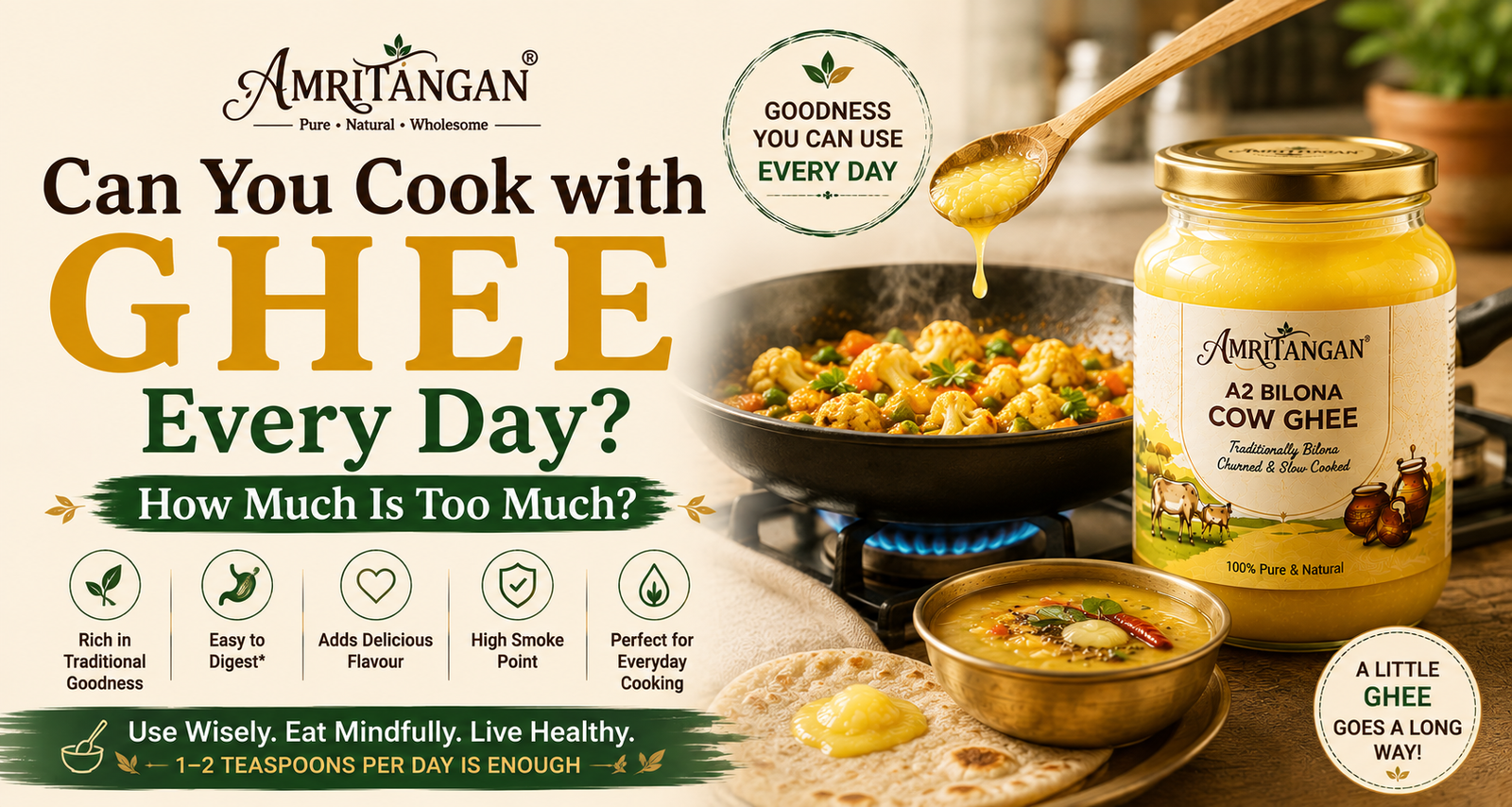
Ghee has been a familiar part of Indian kitchens for generations. From adding a little to dal and khichdi to using it for tadka, roti and traditional recipes, many Indian families use ghee almost every day.
But there is one question that often creates confusion:
Can you cook with ghee every day, or is daily ghee consumption too much?
The answer isn’t simply about whether ghee is “healthy” or “unhealthy.” What matters more is how much you use, how often you use it, and what the rest of your diet looks like.
Ghee is a concentrated source of fat, so using a sensible amount can be very different from adding several spoonfuls to every meal. The same applies to A2 Bilona Ghee—it can be used in everyday cooking, but its traditional preparation doesn’t mean that unlimited consumption is recommended.
In this guide, we’ll explain how much ghee you may need, how to tell when you’re using too much, whether ghee is suitable for daily cooking, how it compares with cooking oil, and practical ways to include it in everyday meals.
Quick Answer
Yes, you can cook with ghee every day if it fits your overall diet and is used in sensible amounts. The important thing is your total daily intake of ghee and other fats—not simply the fact that you use ghee every day.
Yes, ghee can be used for everyday cooking.
Ghee works well in many Indian cooking applications, including tempering dal, sautéing vegetables, preparing khichdi and adding flavour to rice or roti.
However, daily use should not be confused with unlimited use.
Ghee is calorie-dense and contains saturated fat, so the quantity you use matters. If you use a teaspoon for cooking one meal, that is very different from using several tablespoons throughout the day.
The ICMR-NIN Dietary Guidelines for Indians 2024 classify ghee, butter and cooking oils as “visible fats” and recommend limiting visible fat intake according to individual energy needs. The guidelines specifically advise limiting ghee or butter to 1–2 teaspoons per day.
That doesn’t mean everyone must use exactly the same amount. Your overall diet, activity level and individual nutritional requirements also matter.
Ghee can be part of everyday cooking, but portion control is important.
This is one of the most important questions to consider if you use ghee regularly.
Instead of thinking about ghee only as something you “add to food,” think about your total daily intake.
For example, if you:
all of these amounts count toward your total daily intake.
The ICMR-NIN Dietary Guidelines recommend limiting ghee or butter to 1–2 teaspoons per day, while also noting that total visible-fat requirements vary depending on calorie needs and physical activity.
| Ghee Intake | Practical Approach |
| Small amount | Can fit into many balanced diets |
| Around 1 teaspoon | A measured, modest serving |
| 1–2 teaspoons | Within the ghee/butter limit referenced by ICMR-NIN |
| Several tablespoons | A large amount of concentrated fat |
| Large amounts across multiple meals | Easy to overconsume |
The key is to count all the ghee you consume during the day, not just the amount added at one meal.
There isn’t one exact number that is automatically “too much” for every person.
It depends on your overall calorie and fat intake, activity level and individual dietary needs.
However, you’re probably using more ghee than necessary if you’re:
For example, adding a small amount of ghee to dal for flavour is very different from adding several tablespoons to dal, rice and roti at the same meal.
Ghee doesn’t become more beneficial simply because you increase the quantity.
Quality and moderation are more useful principles than “more is better.”
Ghee can be a practical cooking fat for everyday Indian meals.
It has a distinctive aroma and flavour that works particularly well in traditional recipes.
You can use it for:
One of the biggest reasons people choose ghee isn’t necessarily because they expect it to provide a special health benefit—it is simply because it makes food taste good.
And that’s perfectly reasonable.
The important thing is not to turn ghee into either a “miracle food” or something that must be completely avoided.
It can simply be one of the fats used in a balanced diet.
When used sensibly, ghee offers several practical culinary advantages.
A small amount of ghee can add a rich, aromatic flavour to simple foods.
Dal, khichdi, rice and roti are classic examples where a little ghee can make a noticeable difference.
Ghee has a long history in Indian kitchens and is naturally suited to many traditional recipes.
It can be used for tadka, sautéing and other cooking applications.
Like other cooking fats, ghee provides dietary fat and energy.
That doesn’t mean you need large quantities. It simply means that ghee contributes to your overall fat intake and should be considered as part of your complete diet.
A little fat can help carry and distribute flavours from spices and other ingredients.
This is one reason ghee works particularly well with traditional Indian spices.
One of the most common questions is:
Should I use ghee or cooking oil every day?
There isn’t a simple answer where one option is automatically best for everyone.
Both ghee and cooking oils provide fat, and both can contribute to your total calorie intake.
| Factor | Ghee | Cooking Oil |
| Flavour | Rich and distinctive | Depends on the oil |
| Traditional Indian use | Very common | Very common |
| Provides dietary fat | Yes | Yes |
| Calorie-dense | Yes | Yes |
| Portion control needed | Yes | Yes |
| Can be used in cooking | Yes | Yes |
| Best choice for everyone | Not necessarily | Not necessarily |
Different oils also have different fatty-acid profiles, so the best choice depends on the rest of your diet and individual nutritional needs.
Rather than asking “Is ghee always better than oil?”, a more useful question is:
“Which cooking fat fits my diet, and how much am I using?”
Yes, A2 Bilona Ghee can be used for everyday cooking.
You don’t need to save it only for festivals or special occasions.
It can be used in everyday dishes such as:
The Bilona method refers to the traditional process used to prepare the ghee. It doesn’t mean that the finished ghee needs to be consumed in unlimited quantities.
If you’re looking for traditionally prepared ghee for your kitchen, you can explore Amritangan A2 Desi Cow Ghee.
The same basic principle still applies:
Choose a good-quality product, use it sensibly and count it as part of your overall dietary fat intake.
Related Reading – Ghee on an Empty Stomach: Is It Really Good for You?
You don’t need complicated recipes to use ghee.
Here are some simple everyday options.
A small amount of ghee can be added during tadka or directly to a serving of dal.
A light coating of ghee on hot roti is a traditional combination.
Khichdi and ghee are a classic pairing, and a small amount can add flavour to the dish.
A little ghee can be mixed with warm rice, especially when paired with dal or vegetables.
Ghee can be used to sauté or cook selected vegetables.
Depending on the recipe, ghee can also be used in traditional breakfast preparations.
The goal isn’t to add ghee everywhere.
Instead, use it where it genuinely improves the flavour of the food.
This question deserves a balanced answer.
Ghee and cooking oils are not nutritionally identical, and different oils have different fatty-acid compositions.
Ghee contains saturated fat, which is one reason portion control matters.
At the same time, completely removing ghee from your diet isn’t necessary for everyone.
The better approach is to look at your overall dietary pattern.
A balanced diet can include appropriate amounts of different foods and fats rather than relying heavily on one particular ingredient.
So instead of saying “ghee is better than oil,” it’s more accurate to say that ghee can be one option for cooking when used appropriately.
Yes.
Even though ghee can be part of a balanced diet, consuming too much can increase your overall calorie and saturated-fat intake.
Ghee is concentrated fat, which means a relatively small amount provides a significant amount of energy.
Using a little for flavour is very different from consuming several spoonfuls every day.
This is particularly important if you’re already getting substantial amounts of fat from:
The ICMR-NIN guidelines emphasize limiting visible fats and specifically recommend limiting ghee or butter to 1–2 teaspoons per day.
Ghee can be part of your diet, but excessive consumption is not a good idea simply because it is traditionally valued.
Not everyone has the same nutritional requirements.
People who have been advised to limit saturated fat or dietary fat should follow their healthcare professional’s recommendations.
This may include people with:
If your doctor or registered dietitian has advised you to limit saturated fat or dietary fat, don’t replace that personalized advice with a general recommendation about ghee.
This article provides general nutrition information and is not a substitute for personalized medical advice.
You don’t need a large amount of ghee to cook a dish.
Measuring your cooking fat can make portion control much easier.
If you’ve already cooked your food with ghee, adding several more spoonfuls at the end can quickly increase your total intake.
A teaspoon at breakfast, another at lunch and another at dinner adds up.
Think about your whole day, not just one meal.
Traditional preparation and sourcing don’t mean you can consume unlimited quantities.
A2 Bilona Ghee is still a concentrated source of fat.
This is perhaps the biggest mistake.
More isn’t automatically better.
If you enjoy ghee and want to include it in your daily meals, these simple habits can help.
Instead of pouring directly from the jar, use a teaspoon when you’re trying to control portions.
Include ghee used during cooking as well as ghee added after cooking.
A small amount can often provide plenty of flavour.
Ghee should be part of a diet that also includes vegetables, fruits, pulses, whole grains, appropriate protein sources and other nutritious foods.
You may see social media recommendations suggesting that people consume very large quantities of ghee.
There’s no need to follow such trends.
Your daily diet should be based on your nutritional needs rather than viral food hacks.
At Amritangan, we believe ghee should be enjoyed as part of everyday food—not consumed in excessive quantities.
Our A2 Desi Cow Ghee is made using the traditional Bilona approach and can be used in everyday Indian cooking.
You can enjoy it with:
Whether you use it for tadka, cooking or simply add a small amount to your meal, the important thing is to use ghee mindfully.
You can learn more about Amritangan Desi Cow Ghee and how traditionally prepared ghee can fit into an everyday diet.
Yes. Ghee can be used for everyday cooking when consumed in sensible amounts and as part of a balanced diet. The total amount of ghee and other fats you consume during the day is important.
The ICMR-NIN Dietary Guidelines for Indians 2024 advise limiting ghee or butter to 1–2 teaspoons per day, while noting that total visible-fat requirements depend on individual energy needs.
Several tablespoons of ghee every day can be a large amount for many people because ghee is calorie-dense. Your total intake should also include ghee used in cooking and added to meals.
Ghee can be suitable for daily cooking when used in moderation. It is particularly popular for traditional Indian dishes because of its distinctive flavour and aroma.
Yes, A2 Bilona Ghee can be incorporated into everyday meals. However, it should still be consumed in sensible quantities.
There is no universal answer. Ghee and different cooking oils have different nutritional profiles. The appropriate choice depends on your overall diet, cooking needs and individual nutritional requirements.
Excessive ghee intake can increase overall calorie intake, which may contribute to weight gain if it leads to a sustained calorie surplus.
Use enough to prepare the food properly and provide the desired flavour, rather than adding large amounts automatically. Measuring your ghee can help with portion control.
Ghee doesn’t automatically prevent weight loss, but it can fit into a calorie-conscious diet when used in appropriate quantities. Total calorie intake and overall diet are more important than simply avoiding or adding one food.
For many people, one teaspoon is a modest amount. Whether you need more or less depends on your overall diet and how much fat you get from other sources.
Yes, you can cook with ghee every day—but the quantity matters.
Ghee has an important place in traditional Indian cooking, and there’s no need to treat it as something that can only be used occasionally. A sensible amount can add flavour to dal, roti, rice, khichdi and many other everyday dishes.
The bigger problem isn’t necessarily daily ghee use. It’s excessive ghee use.
Remember that every teaspoon used for cooking, added to roti or mixed into your meal contributes to your total daily intake.
So rather than asking whether ghee is completely good or completely bad, ask a more useful question:
“Am I using the right amount of ghee for my overall diet?”
If the answer is yes, you can enjoy the rich taste of ghee without overdoing it.
And if you’re choosing Amritangan A2 Bilona Ghee, use it the same way you would use any concentrated cooking fat: choose quality, enjoy the flavour, and keep your portions sensible.
No account yet?
Create an AccountNeed help? Our team is just a message away